Showing posts with label financial crisis. Show all posts

Thursday, July 10, 2014

Arun Jaitley's Budget 2014-15, or a UPA-3 budget?

R. Ramakumar

The first budget of the Narendra Modi government, in its core thrust, represents continuity with the UPA-2 government's economic policy. In fact, Arun Jaitley's budget presents nothing innovative at all in the way it intends to deal with the challenges of low growth, high inflation and the persistence of socio-economic backwardness. His is a fall back on the old and failed strategy: contain fiscal policy, hope that it would pull down interest rates and encourage private investment, and place emphasis on foreign capital inflows to revive growth.

In his speech, Jaitley did not hide his awe for his predecessor with regard to fiscal consolidation. After stating that P. Chidambaram had set a “very difficult task” of cutting fiscal deficit to 4.1 per cent in 2014-15, Jaitley put forward his own road map for the next three years. Between 2013-14 and 2016-17, the fiscal deficit is to fall from 4.6 per cent to 3 per cent; and the revenue deficit is to fall from 3.3 per cent to 1.6 per cent. Such fiscal consolidation is to take place with no comparable rise in revenues, which would have been a progressive and expenditure-neutral road map. Gross tax revenue is targeted to rise only moderately from 10.2 per cent in 2013-14 to 11.2 per cent in 2016-17. In other words, Jaitley's fiscal consolidation path would be marked by sharp expenditure compression till 2016-17.

Expenditure cuts had begun during the last two years of the UPA-2 government itself. Between 2012-13 and 2013-14, the tax to GDP ratio fell from 10.2 per cent to 10.0 per cent, mainly on account of a fall in central excise collections by Rs 6,376 crore. The UPA-2 government also gave significant tax concessions to the corporates and the rich. If Rs 566,234 crore was the total revenue foregone in 2012-13, the total revenue foregone in 2013-14 was higher at Rs 572,924 crore. To cover for the losses in revenue, Chidambaram cut expenditures across the board; for 2013-14, the revised estimates on a variety of expenditure heads are lower than the budgeted estimates. He also aimed to disinvest heavily to open a regular channel that would fund public spending. In 2013-14, Chidambaram raised Rs 21,992 crore from disinvestment proceeds. However, in an election year, there were limits to disinvestment.

Jaitley's promise is to pick up the threads from where Chidambaram left. First, for 2014-15, Jaitley has promised an intensive disinvestment policy to raise non-debt generating revenues, and is hoping to raise Rs 55,000 crore in 2015-16 and 2016-17. In the public banking sector, Jaitley has opened the doors of a “creeping privatisation” policy by allowing them sale of shares to raise their capital requirements. Thus, the Modi government wants to step up the privatisation policy of the UPA-2 government to a totally new plane. Secondly, Jaitley also wishes to continue the go-slow policy on the question of charging retrospective taxes on corporate houses. By all accounts, he has assured them of a soft scrutiny mechanism by the CBDT before any action. Thirdly, Jaitley has signalled that he would continue compressing expenditures to bolster his road map for fiscal consolidation.

In the social and economic sectors, expenditure compression is likely to be acute in 2014-15. While the Modi government has kept most central schemes intact, the allocations to these schemes have either fallen or are stagnant. In the National Rural Livelihood Mission (NRLM), if the expenditure in 2013-14 was Rs 2371.30 crore, the budgeted allocation for 2014-15 is only marginally higher at Rs 2486 crore. The budget for the National Rural Empployment Guarantee Scheme has risen by just Rs 364 crore: from Rs 33,000 crore in 2013-14 to Rs 33,364 crore in 2014-15.

In addition, Jaitley has promised that subsidies would be “more targeted”. Targeting of subsidies is always a code for expenditure cuts. While the food subsidy is to rise by about Rs 23,000 crore, thanks to an entitlement-based Act, other subsidies are to be limited. For instance, petroleum subsidy is to fall from Rs 85,480 crore in 2013-14 to Rs 63,427 crore in 2014-15: a decline of Rs 22,053 crore. Fertiliser subsidy is to rise only marginally by Rs 4999 crore, from Rs 67,971 crore in 2013-14 to Rs 72,970 crore in 2014-15. Within fertilisers, there appears to be a rise in urea subsidy and a fall in subsidies for potash (K) and phosphoric (P) fertilisers. Between 2013-14 and 2014-15, while the overall fertiliser subsidy is to rise by Rs 4,999 crore, subsidy on urea is to rise by Rs 9,500 crore and the subsidy on decontrolled fertilisers is to fall by Rs 4,757 crore. Such a policy is likely to increase the relative prices of P and K fertilisers compared to urea, and lead to further imbalances in the N:P:K application ratio by farmers.

Finally, if Chidambaram focussed all his energies on inviting foreign capital to boost economic growth, Jaitley has promised not to be left behind. He has increased the cap of FDI in the defense sector from 26 per cent to 49 per cent. The FDI cap in the insurance sector has also been increased from 26 per cent to 49 per cent. FDI is also sought to be given a major share of the pie in the highly speculative real-estate sector. In the name of developing Smart Cities, the requirement of the built-up area for FDI has been reduced from 50,000 square metres to 20,000 square metres. The capital conditions for FDI in this sector has also been reduced from USD 10 million to USD 5 million.

In sum, the first budget of the Modi government could also be billed as the possible first budget of a UPA-3 government. In my analysis of the UPA's last full budget in the Asian Age, dated 1st March 2013, I had argued that Chidambaram's was “a poll calculation gone wrong”. The UPA was taught a harsh lesson by India's people in May 2014. The Modi government, once in power, seems intent on treading the same path. It is just a reaffirmation that there are no differences at all between the economic policies of the UPA and the NDA.

Wednesday, August 28, 2013

ഇടിയുന്ന രൂപയും ആഗോളവൽക്കരണവും

ആർ. രാംകുമാർ


രൂപയുടെ മൂല്യമിടിയുന്നതിനെ പറ്റി ഇന്റർനെറ്റിൽ പരക്കെയുള്ള ഒരു തമാശ ഇങ്ങിനെ: 1991-ൽ ഉദാരവല്ക്കരണം ആരംഭിക്കുമ്പോൾ ഒരു ഡോളറിനു തുല്യമായ രൂപയുടെ മൂല്യം രാഹുൽ ഗാന്ധിയുടെ അന്നത്തെ വയസ്സിനു തുല്യം (17 രൂപ). 2013-ൽ അത് രാഹുലിന്റെ അമ്മയായ സോണിയ ഗാന്ധിയുടെ ഇന്നത്തെ വയസ്സിനു തുല്യം (66 രൂപ). എന്നാൽ പ്രധാനമന്ത്രി മൻമോഹൻ സിങ്ങിനു ഒരു ലക്ഷ്യമുണ്ട്. താൻ 2014-ൽ പടിയിറങ്ങുമ്പോൾ ആ നിരക്കിനെ തന്റെ സ്വന്തം വയസ്സിനടുത്ത് എങ്ങിനെയെങ്കിലും എത്തിക്കണം (80 രൂപ). ഇപ്പറഞ്ഞത്‌ തമാശയായാണെങ്കിലും, കാര്യങ്ങൾ ഇങ്ങിനെ പോയാൽ ഒരു ഡോളറിനു 80 രൂപ എത്തുന്ന കാലം അത്ര വിദൂരമല്ല എന്നാണു വിദഗ്ധർ അഭിപ്രായപ്പെടുന്നത്. അത് കൊണ്ടായിരിക്കും, "ക്ഷമ വേണം, രൂപ അതിന്റെ ശരിയായ മൂല്യത്തിൽ എത്തിക്കൊള്ളും" എന്ന് ധനമന്ത്രി ചിദംബരം പറഞ്ഞതായി വാർത്ത വന്നിട്ടുള്ളത്!

എന്താണ് രൂപയുടെ മൂല്യമിടിയുന്നതിന്റെ പിന്നിലെ കാരണങ്ങൾ? ആരാണ് അതിനു ഉത്തരവാദി? ആഗോളതലത്തിലെ മാറ്റങ്ങൾ മാത്രമാണോ? അതോ ഇന്ത്യയിലെ സർക്കാരിന്റെ നയവൈകല്യങ്ങളോ? ഈ വിഷയങ്ങൾ ചുരുക്കത്തിൽ പരിശോധിക്കുക എന്നതാണ് ഈ ലേഖനത്തിന്റെ ലക്‌ഷ്യം.

മൂല്യത്തകർച്ചയുടെ ചരിത്രം

1947-ൽ ഇന്ത്യക്ക് സ്വാതന്ത്ര്യം ലഭിക്കുമ്പോൾ ഒരു ഡോളറിനു മൂല്യം 3.30 രൂപ. 1947-ലെ സ്ഥിതിക്ക് ഒരു കാരണമുണ്ടായിരുന്നു. അന്ന് ഇന്ത്യൻ രൂപയുടെ മൂല്യം ബ്രിട്ടീഷ്‌ പൌണ്ടിനെ അടിസ്ഥാനപ്പെടുത്തിയായിരുന്നു നിശ്ചയിച്ചിരുന്നത്. ഒരു പൌണ്ടിന് 13.33 രൂപ മൂല്യം. ഒരു പൌണ്ടിന് 4.03 ഡോളർ മൂല്യം. അങ്ങിനെ, ഒരു ഡോളറിനു 3.30 രൂപ. 1949-ൽ പൌണ്ടിന്റെ മൂല്യമിടിഞ്ഞു. അത് വഴി രൂപയുടെയും. 1949 മുതൽ 1966 വരെ ഒരു ഡോളറിനു 4.76 രൂപ എന്ന നിരക്കായിരുന്നു നിലവിൽ ഉണ്ടായിരുന്നത്. എന്നാൽ അന്നും ഇന്നും തമ്മിൽ ഒരു പ്രധാന വ്യത്യാസമുണ്ട്. അന്ന് രൂപയുടെ മൂല്യം ഇന്നത്തെ പോലെ കറൻസി വിപണികളിലല്ല നിർണയിച്ചിരുന്നത്. മറിച്ചു, സർക്കാർ തന്നെയാണ് സാമ്പത്തിക സ്ഥിതി കണക്കിലെടുത്തു കൊണ്ട് രൂപയുടെ മൂല്യം നിശ്ചയിച്ചിരുന്നത്. ഇതിനു "നിശ്ചിത-വിനിമയ-നിരക്ക്-വ്യവസ്ഥ" (fixed exchange rate regime) എന്നായിരുന്നു പേര്. 

1966 ലാണ് ഇന്ത്യ ആദ്യമായി ഒരു സാമ്പത്തിക പ്രതിസന്ധിയെ നേരിടുന്നത്. അടുത്തടുത്ത രണ്ടു യുദ്ധങ്ങൾ ഇന്ത്യയുടെ സമ്പദ്-വ്യവസ്ഥയെ താറുമാറാക്കിയിരുന്നു. രാജ്യത്തിന്റെ വ്യാപാര കമ്മി ഏറെ വർദ്ധിച്ചിരുന്നു. അമേരിക്കയിൽ നിന്നുള്ള സഹായധനം (aid) കിട്ടുന്നതും അവസാനിച്ചിരുന്നു. കൂടുതലും ഭക്ഷ്യധാന്യമായിരുന്നു അമേരിക്കയിൽ നിന്നും സഹായധനമായി കിട്ടിക്കൊണ്ടിരുന്നത്. തുടർന്ന് ഭക്ഷണസഹായം നൽകണമെങ്കിൽ രൂപയുടെ മൂല്യമിടിച്ച്ചേ പറ്റൂ എന്ന് അമേരിക്ക നിർബന്ധം പിടിച്ചു. ഒപ്പം, ഐ.എം.എഫിന്റെയും ലോകബാങ്കിന്റെയും സമ്മർദവും. ഈ സമ്മർദങ്ങൾക്ക് വഴങ്ങി ഇന്ദിര ഗാന്ധി 1966-ൽ രൂപയുടെ മൂല്യം ഡോളറിനു 7.57 എന്നാക്കി കുറച്ചു (ഈ തീരുമാനമെടുക്കുന്നതിന് തലേന്ന് രാത്രി ആകെ ടെൻഷനടിച്ച ഇന്ദിര "ഡോക്ടർ ഷിവാഗോ" എന്ന സിനിമ കാണാൻ പോയി എന്നും ഒരു കഥയുണ്ട്). ഇങ്ങിനെ മൂല്യം കുറച്ചാൽ ഇന്ത്യയിൽ നിന്നുള്ള കയറ്റുമതികൾക്ക് കൂടുതൽ അനുകൂലമായ സ്ഥിതിയുണ്ടാവും; അങ്ങിനെ കൂടുതൽ ഡോളർ കൈവശം വരും; ആ ഡോളർ ഉപയോഗിച്ചു  ഭക്ഷണം, എണ്ണ തുടങ്ങിയ ചരക്കുകൾ ഇറക്കുമതി ചെയ്യാം; എന്നൊക്കെ ഇന്ദിര ഗാന്ധി കണക്കു കൂട്ടിയിരുന്നു. കയറ്റുമതിയൊന്നും കാര്യമായി വർദ്ധിച്ചില്ലെങ്കിലും, ഇന്ത്യയിൽ അന്ന് നിലവിൽ ഉണ്ടായിരുന്ന കടുത്ത ഇറക്കുമതി നിയന്ത്രണങ്ങൾ കാരണം ഇറക്കുമതികൾ  കാര്യമായി വർദ്ധിച്ച്ചില്ല. അത് മൂലം, ഇന്നത്തെ പോലെ രാജ്യത്തിന്റെ വിദേശനാണയ ശേഖരം നഷ്ടപ്പെടുന്ന സ്ഥിതി ഉണ്ടായില്ല.

1975 മുതൽ രൂപയുടെ മൂല്യം നിർണ്ണയിക്കുന്ന രീതി സർക്കാർ മാറ്റി. അമേരിക്കൻ ഡോളർ, ജപ്പാനീസ് യെൻ, ജർമൻ മാർക്ക് എന്നീ മൂന്ന് കറൻസികളുടെ നിലവാരവുമായി ബന്ധപ്പെടുത്തിയായിരുന്നു പുതിയ മൂല്യ നിർണ്ണയ രീതി. അങ്ങിനെ ഒരു ഡോളറിനു രൂപയുടെ മൂല്യം 7.57 ൽ നിന്ന് 8.39 ആയി സർക്കാർ കുറച്ചു. 1985-ൽ ഇത് വീണ്ടും കുറച്ചു ഒരു ഡോളറിനു 12 രൂപ എന്നാക്കി.

ഉദാരവല്ക്കരണവും മൂല്യത്തകർച്ചയും

അപ്പോഴാണ്‌ 1991-ൽ ഉദാരവൽക്കരണത്തിന്റെയും ആഗോളവൽക്കരണത്തിന്റെയും വരവ്. 1980-കളിൽ പുറം രാജ്യങ്ങളിൽ നിന്നും കടം വാങ്ങിയായിരുന്നു ആഭ്യന്തര നികുതി പിരിക്കാത്ത ഇന്ത്യൻ സർക്കാർ ചിലവുകൾ നടത്തിയിരുന്നത്. ഈ കടങ്ങളൊക്കെ തിരികെ നല്കേണ്ടത് ഡോളറിൽ ആയിരുന്നു. അന്നന്നത്തെ ചിലവുകൾക്ക് ഉപയോഗിക്കുന്ന, മൂലധന ചിലവുകൾക്ക് ഉപയോഗിക്കാത്ത, ഈ കടം വാങ്ങിയ പണം എങ്ങിനെ തിരിച്ചടക്കും? ആ പ്രതിസന്ധി സമയത്താണ് ഗൾഫു യുദ്ധം പൊട്ടിപുറപ്പെടുന്നത്. ഒന്നാമതായി, ഇത് മൂലം എണ്ണ വില വൻതോതിൽ വർദ്ധിച്ചു; കൂടിയ വിലയിൽ എണ്ണ വാങ്ങാൻ കൂടുതൽ ഡോളർ ശേഖരം ചിലവഴിക്കണം. രണ്ടാമതായി, ഇന്ത്യയുടെ ഡോളർ ശേഖരം കൂടുതലായും ഗൾഫിലെ തൊഴിലാളികൾ നാട്ടിലേക്കയച്ച്ചിരുന്ന വരുമാനത്തിൽ നിന്നായിരുന്നു. യുദ്ധം മൂലം ലക്ഷക്കണക്കിന്‌ തൊഴിലാളികൾ ഇന്ത്യയിലേക്ക്‌ മടങ്ങി. അങ്ങിനെ ഡോളർ ശേഖരം ചുരുങ്ങി. മൂന്നാമതായി, യുദ്ധം മൂലം ഗൾഫു മേഖലയിലേക്കുള്ള ഇന്ത്യയുടെ കയറ്റുമതികൾ കുറഞ്ഞു. അത് മൂലം, ആ കയറ്റുമതികൾ നേടി തന്നിരുന്ന ഡോളറുകൾ നഷ്ടമായി. അങ്ങിനെ രൂപയുടെ മൂല്യത്തിനു മേൽ കടുത്ത സമ്മർദം വന്നു.


ഒപ്പം കൂട്ടി വായിക്കേണ്ട മറ്റൊരു കാര്യം കൂടിയുണ്ട്. ഇന്ത്യയിൽ അന്ന് നിലവിൽ നിന്നിരുന്ന രാഷ്ട്രീയ അസ്ഥിരത മൂലം നിക്ഷേപകർ മെല്ലെ ഇന്ത്യയിൽ നിന്നും പണം പിൻവലിക്കാൻ തുടങ്ങി. പ്രധാനമായും വിദേശ ഹ്രസ്വകാല വായ്പ്പകൾ നൽകിയവരാണ് വായ്പ്പാ കാലയളവ്‌ വർദ്ധിപ്പിക്കാൻ നില്ക്കാതെ സ്ഥലം വിട്ടത്. ഇവർ വന്നത് ഡോളറുമായാണ്. പോയതും ഡോളറും കൊണ്ട്. ഇത് മൂലം, ഡോളർ ശേഖരം വീണ്ടും ഇടിഞ്ഞു. ഇതോടൊപ്പം, എൻ.ആർ.ഐ (NRI) നിക്ഷേപകരും ഇന്ത്യയിൽ നിന്നും പണം പിൻവലിക്കാൻ തുടങ്ങി. അവരും കൊണ്ട് പോയത് ഡോളർ.

ഈ സാഹചര്യത്തിലാണ്, 1966-ലെ പോലെ, ഐ.എം.എഫിന്റെയും ലോകബാങ്കിന്റെയും സമ്മർദത്തിനു വീണ്ടും വഴങ്ങി ഇന്ത്യ ഉദാരവല്ക്കരണ നയങ്ങൾ അവലംബിച്ചത്. ഈ നയങ്ങളുടെ ആദ്യ ദിനങ്ങളിൽ രൂപയുടെ മൂല്യമിടിക്കലിനാണ് പ്രാമുഖ്യം കിട്ടിയത്. അങ്ങിനെ ഒരു ഡോളറിനു 12 രൂപ എന്നതിൽ നിന്നും കുറച്ചു ഒരു ഡോളറിനു 17.90 രൂപ എന്നാക്കി മൂല്യം നിശ്ചിതപ്പെടുത്തി (ഇതാണ് നേരത്തെ രാഹുൽ ഗാന്ധിയുടെ അന്നത്തെ പ്രായവുമായി തമാശരൂപേണ താരതമ്യപ്പെടുത്തിയത്). എന്നാൽ, 1993 ൽ ആണ് ഏറ്റവും പ്രധാനപ്പെട്ട നയവ്യതിയാനം ഉണ്ടായത്. വർഷങ്ങളായി ഐ.എം.എഫും ലോകബാങ്കും ആവശ്യപ്പെട്ടു വന്നിരുന്ന ഒരു നയം അന്ന് മുതൽ പ്രാവർത്തികമായി. 1947 മുതൽ നിലവിൽ ഉണ്ടായിരുന്ന "നിശ്ചിത-വിനിമയ-നിരക്ക്-വ്യവസ്ഥ" എടുത്തു കളഞ്ഞ്, കറൻസിയുടെ മൂല്യനിർണ്ണയം പൂർണമായും കറൻസി വിപണിക്ക് വിട്ടു നല്കി. അതായത്, വിപണിയിലെ സ്ഥിതി അനുസരിച്ചായിരിക്കും രൂപയുടെ മൂല്യം നിർണ്ണയിക്കപ്പെടുക; ഒരുപാട് ഉയര്‍ച്ചയും താഴ്ചയും ഉണ്ടായാൽ മാത്രം റിസർവ് ബാങ്ക് ഇടപെടും. അങ്ങിനെ 1993 മുതൽ ഒരു ഡോളറിനു 31.37 രൂപ എന്നതായി നിരക്ക്. അവിടെ നിന്നും വീണ്ടും കുറഞ്ഞു 40 രൂപക്കും 50 രൂപക്കും ഇടയ്ക്കായിരുന്നു 2000നും 2010നും ഇടയ്ക്കു രൂപയുടെ മൂല്യം. ഇന്നത്‌ ഒരു ഡോളറിനു 66 രൂപയിൽ എത്തി നില്ക്കുന്നു (ചിത്രം 1 കാണുക).

ചിത്രം 1: 1991 മുതൽ 2013 വരെയുള്ള രൂപയുടെ മൂല്യതകർച്ച്ച, ഒരു ഡോളറിനു എത്ര രൂപ എന്ന നിരക്കിൽ 


ഇന്നത്തെ രൂപയുടെ മൂല്യതകർച്ച്ച മനസ്സിലാക്കാൻ 2000 മുതല്ക്കുള്ള സാമ്പത്തിക നയങ്ങൾ എടുത്തു പരിശോധിക്കുക അനിവാര്യമാണ്. ഇതിൽ ചില വിഷയങ്ങൾ ചില ആഴ്ച്ചകൾക്കു മുൻപ് ചിന്ത വാരികയിൽ ചർച്ച ചെയ്യാൻ ശ്രമിച്ചിരുന്നു ("ഇന്ത്യൻ സമ്പദ്-വ്യവസ്ഥയിലെ മുരടിപ്പ്" എന്ന ലേഖനം). അവയിൽ നിന്ന് രൂപയുടെ മൂല്യതകർച്ചയുമായി ബന്ധപ്പെട്ട വിഷയങ്ങൾ മാത്രമെടുത്ത് ചർച്ച ചെയ്യാനാണ് ഇവിടെ ഉദ്ദേശിക്കുന്നത്.

2000-കളിലെ നയങ്ങളും മൂല്യത്തകർച്ചയും

ഏകദേശം 2003-04 മുതലുള്ള വർഷങ്ങളിൽ ഇന്ത്യയുടെ വാർഷിക സാമ്പത്തിക വളർച്ചാ നിരക്ക് ഏകദേശം 8 ശതമാനം ആയിരുന്നു. 1990-കളിലെ 6 ശതമാനം എന്ന ശരാശരിയിൽ നിന്നും വലിയൊരു കുതിപ്പായിരുന്നു ഇത്. എന്താണ് ഈ വളർച്ചക്ക് അടിസ്ഥാനമായിരുന്നത്? ആഗോളവല്ക്കരണ നയങ്ങളുടെ ഭാഗമായി തന്നെയുണ്ടായ ഒരു താത്കാലിക പ്രതിഭാസമായിരുന്നു ഇതെന്ന് ഇന്ന് വ്യക്തമാണ്. പുതിയ നൂറ്റാണ്ടിലെ ആദ്യ ദശകത്തിലെ തുടക്കം മുതൽ തന്നെ ഇന്ത്യയിലെ ധനകാര്യ വിപണികളിലേക്ക് ഒഴുകിയെത്തിയ വിദേശ മൂലധനമായിരുന്നു ഈ കുതിപ്പിന് തുടക്കം കുറിച്ചത്. എന്ത് കൊണ്ട് ഇതുണ്ടായി? പാശ്ചാത്യ രാജ്യങ്ങളിൽ അന്ന് നിലവിൽ ഉണ്ടായിരുന്നത് വളരെ അയവുള്ള ഒരു മോണിട്ടറി നയമായിരുന്നു; അതായത്, പണം എളുപ്പത്തിൽ ലഭ്യമായ ഒരു സാമ്പത്തിക അന്തരീക്ഷം. അങ്ങിനെ വന്നപ്പോൾ, പലിശ നിരക്കുകൾ വളരെ കുറവായി. ആ അവസ്ഥയിൽ, കൂടുതൽ പലിശ ലഭ്യമായ ഇന്ത്യ പോലുള്ള വികസ്വര രാജ്യങ്ങളിലെ സാമ്പത്തിക വിപണികളിലായി അന്താരാഷ്‌ട്ര നിക്ഷേപകരുടെ ശ്രദ്ധ. പലിശ നിരക്കുകളിലെ അന്തരം എങ്ങിനെ നിക്ഷേപം നടത്തി ലാഭമാക്കി മാറ്റാം എന്നതായിരുന്നു നോട്ടം. അങ്ങിനെയാണ്, വികസ്വര വിപണികളിലേക്ക് വൻതോതിൽ വിദേശ പണം ഒഴുകിയെത്തിയത്.

ഇങ്ങിനെ ഒഴുകിയെത്തിയ പണം വളർച്ചാ നിരക്കുകൾ വർദ്ധിപ്പിച്ച്ചത് കൊണ്ട് സർക്കാരിന് പരാതിയുണ്ടായില്ല. എന്നാൽ ഈ പണം കടം വാങ്ങിയ പണത്തിനു തുല്യമാണെന്ന് അവർ കരുതിയില്ല; അല്ലെങ്കിൽ, കരുതിയിരുന്നു, പക്ഷെ അവഗണിച്ചു. എന്ത് കൊണ്ടാണിത് കടത്തിന് തുല്യം എന്ന് പറയുന്നത്? ഈ നിക്ഷേപകർ ഇന്ത്യയിൽ നിക്ഷേപിക്കുമ്പോൾ അവർ ഡോളറും കൊണ്ടാണ് വരിക. ആ ഡോളർ നമ്മൾ വാങ്ങി രൂപ കൊടുക്കുന്നു. ഈ ഡോളർ നമ്മുടെ വിദേശനാണയ ശേഖരത്തിലേക്ക് പോകും. ഈ പണം കയറ്റുമതികൾ മൂലമാണ് കിട്ടിയിരുന്നത് എങ്കിൽ തിരിച്ചു കൊടുക്കേണ്ട. പക്ഷെ, ഈ നിക്ഷേപകർ നാളെ തിരിച്ചു പോകാം. പോകുമ്പോൾ അവർ ഡോളറും കൊണ്ടാണ് പോകുക. അവർ ചോദിക്കുമ്പോൾ ചോദിക്കുന്ന ഡോളർ കൊടുക്കാൻ കഴിയണം. കൊടുക്കാൻ കഴിഞ്ഞില്ലെങ്കിൽ, അത് രാജ്യത്തിന്റെ അന്താരാഷ്‌ട്ര തലത്തിലെ വിശ്വാസ്യതയെ തകർക്കും. കൂടുതൽ വലിയ തോതിൽ നിക്ഷേപങ്ങൾ പുറത്തേക്ക് ഒഴുകാൻ ആരംഭിക്കും. ഭാവിയിൽ നിക്ഷേപം രാജ്യത്തിലേക്ക് വരുന്നത് അവസാനിക്കും. അപ്പോൾ, ചോദിക്കുമ്പോൾ ഡോളർ കൊടുത്തേ തീരൂ. അങ്ങിനെ ഒരുപാട് കൊടുത്താൽ എന്ത് സംഭവിക്കും? അത് ആഭ്യന്തര കറൻസിയായ രൂപയുടെ മൂല്യമിടിക്കും.

വിവേകബുദ്ധിയുള്ള ഒരു സർക്കാർ ഇത് തിരിച്ചറിഞ്ഞു പ്രവർത്തിക്കേണ്ടതാണ്. എന്നാൽ, വളർച്ചാ നിരക്കിന്റെ ആഹ്ളാദതിമിർപ്പിൽ ഈ തിരിച്ചറിവ് എവിടെയുണ്ടാവാൻ? യഥാർത്ഥത്തിൽ കടം വാങ്ങിയ പണം കൊണ്ടുള്ള ഈ വളർച്ചാ പാത അപകടം നിറഞ്ഞതാണ്‌ എന്ന് അന്ന് തന്നെ ഇടതുപക്ഷ നിരീക്ഷകർ പറഞ്ഞതാണ്. അവർ "വളർച്ചാ വിരോധികർ" എന്നായിരുന്നു നവ-ലിബറൽ ആക്ഷേപം.

ഈ വളർച്ചാ പാതയ്ക്ക് മറ്റൊരു പ്രശ്നം കൂടിയുണ്ടായിരുന്നു. പൂർണമായും അസമത്വം നിറഞ്ഞതായിരുന്നു ഈ പാത. സമൂഹത്തിലെ ഒരു ചെറിയ വിഭാഗത്തിനു മാത്രം ഗുണം ചെയ്ത, അവരുടെ ചോദനം മാത്രം വർദ്ധിപ്പിച്ച, ദരിദ്രജന വിഭാഗങ്ങളുടെ ജീവനോപാധികളെ കൂടുതൽ പ്രതിസന്ധിയിലേക്ക് തള്ളി വിട്ട, ഒരു കാലയളവായിരുന്നു ഇത്. സമ്പന്നജനവിഭാഗങ്ങളുടെ ചോദനം വളർന്നത്‌ കൂടുതൽ ഇറക്കുമതിയധിഷ്‌ഠിതമായ ചരക്കുകളിലായിരുന്നു. അത് കൊണ്ട് തന്നെ ഇറക്കുമതികൾ വർദ്ധിച്ചു. ഒപ്പം തന്നെ എണ്ണ, സ്വർണ്ണം എന്നീ ചരക്കുകളുടെയും ഇറക്കുമതി വർദ്ധിച്ചു. ഇറക്കുമതിയുണ്ടാകുമ്പോൾ, ഡോളറിലാണ് വില നൽകേണ്ടത്. അത് വിദേശനാണയ നിക്ഷേപത്തെ ദുർബലപ്പെടുത്തും. വലിയ തോതിൽ നിക്ഷേപങ്ങൾ വന്നു കൊണ്ടിരുന്നപ്പോഴും അതിൽ ഒരു ഭാഗം ഇങ്ങിനെ ഇറക്കുമതികൾക്ക് നല്കാൻ മാറ്റി വെക്കപ്പെട്ടിരുന്നു എന്നത് മറച്ചു വെക്കാൻ കഴിയില്ല.

2008-ലെ ആഗോള പ്രതിസന്ധി

2008-ലെ ആഗോള സാമ്പത്തിക പ്രതിസന്ധി ഒരു ചെറിയ കാലവയളവിൽ വരാൻ പോകുന്ന അപകടത്തിന്റെ ഒരു ചെറിയ രൂപം കാട്ടി കൊടുത്തിരുന്നു എന്നതും ഓർക്കണം. പ്രതിസന്ധിയുണ്ടായപ്പോൾ, പുറം രാജ്യങ്ങളിലെ ധനവിപണികളിൽ തങ്ങൾക്കുണ്ടായ നഷ്ഠങ്ങൾ നികത്താൻ വിദേശ നിക്ഷേപകർ വലിയ തോതിൽ പണം പുറത്തേക്ക് കൊണ്ട് പോയിരുന്നു. അവർക്കൊക്കെ ഡോളറിൽ പണം നല്കേണ്ടത് കൊണ്ട് തന്നെ രൂപയുടെ മൂല്യത്തിൻ മേൽ വലിയ സമ്മര്‍ദ്ധം അന്ന് തന്നെ ഉണ്ടായി. 2008 നും 2009 നും ഇടയ്ക്കു ഒരു ഡോളറിനുള്ള രൂപയുടെ മൂല്യം 40 രൂപയിൽ നിന്നും 52 രൂപയായി ഉയർന്നിരുന്നു.

എന്നാൽ, 2009-നു ശേഷം അമേരിക്കൻ സർക്കാരിന്റെ ചെലവ്-കൂട്ടൽ നയം മൂലം ഈ സ്ഥിതി മാറി. ബാങ്കുകളെ തകര്‍ച്ചയില്‍നിന്ന് രക്ഷിക്കാനായി ബാങ്കുകളുടെ കൈവശമുള്ള ബോണ്ടുകള്‍ സര്‍ക്കാര്‍ വാങ്ങിക്കൂട്ടി. ഇങ്ങിനെ എല്ലാ വർഷവും ബോണ്ടുകൾ വാങ്ങി കൊണ്ടിരുന്നത് കൊണ്ട് തന്നെ അത് വഴി ചിലവഴിച്ചു കൊണ്ടിരുന്ന പണം മുഴുവനും ആദ്യം അമേരിക്കൻ സമ്പദ് ഘടനയിലും, പിന്നീട് ആഗോള സമ്പദ് ഘടനയിലും ചെന്നെത്തി. ഇതിൽ വലിയൊരു ഭാഗം ഇന്ത്യയിലെ ഓഹരി കമ്പോളങ്ങളിലും വന്നു. ഈ പണം വരാൻ തുടങ്ങിയതോടു കൂടി ഇന്ത്യൻ ധനവിപണിക്ക് വീണ്ടും ജീവൻ വെച്ചു. വിദേശനാണയ നിക്ഷേപം വീണ്ടും വളരാൻ തുടങ്ങി. രൂപയ്ക്കു മൂല്യം കൂടി. അങ്ങിനെ ഒരു ഡോളറിനു 52 രൂപ എന്നായിരുന്നത് 2011-ന്റെ മദ്ധ്യത്തോടു കൂടി ഒരു ഡോളറിനു ഏകദേശം 44 രൂപ വരെ എത്തി നിന്നു. വിദേശ നിക്ഷേപകർ തിരിച്ചെത്തിയത്‌ മൂലമാണ് ഇതുണ്ടായത് എന്ന് അന്ന് തന്നെ മനസ്സിലാക്കണമായിരുന്നു. അവർ എപ്പോൾ വേണമെങ്കിലും വീണ്ടും തിരിച്ചു പോകാമെന്നും, അന്ന് വീണ്ടും ഇതേ പ്രതിസന്ധി തന്നെ വീണ്ടും ഉണ്ടാവും എന്നും തിരിച്ച്ചറിയേണ്ടതല്ലേ? അതുണ്ടായില്ല.

2012 മുതൽ വീണ്ടും മൂല്യതകർച്ച

ഇടതുപക്ഷ നിരീക്ഷകർ മുന്നറിയിപ്പ് നല്കിയിരുന്നത് പോലെ തന്നെ, 2012 ആരംഭം മുതൽ വന്ന പണം വീണ്ടും തിരിച്ചു പോകാൻ ആരംഭിച്ചു. അതായത്, ഇന്ന് നാം കാണുന്ന വലിയ തോതിലുള്ള മൂല്യതകർച്ച്ചയുടെ ആരംഭം 2012-ന്റെ ആരംഭം മുതലായിരുന്നു. 2011 ആഗസ്റ്റ്‌ മാസത്തിൽ ഒരു ഡോളറിനു 44 രൂപയായിരുന്നു. 2012 ജൂണ്‍ മാസത്തോടു കൂടി ഒരു ഡോളറിനു 55 രൂപ എന്ന സ്ഥിതിയായി. എന്ത് കൊണ്ടാണ് 2012 മുതൽ ഇങ്ങിനെ രൂപയ്ക്കു മൂല്യമിടിഞ്ഞത്? അവിടെയാണ് കറണ്ട് അക്കൗണ്ട് കമ്മി എന്ന പ്രതിഭാസത്തിന്റെ പ്രാധാന്യം.

നവലിബറൽ നയങ്ങളുടെ ഭാഗമായി കടന്നു വന്നിട്ടുള്ള ഒരു പ്രതിസന്ധിയാണ് വളർന്നു വരുന്ന കറണ്ട് അക്കൗണ്ട് കമ്മി. തുറന്ന വ്യാപാര നയങ്ങളുടെ ഭാഗമായി ഇന്ത്യയിലേക്ക്‌ ഒഴുകിയെത്തുന്ന ഇറക്കുമതികളും, വളരാതെ നില്ക്കുന്ന കയറ്റുമതികളും കൂടി വരുത്തി വെച്ചിട്ടുള്ള വിനയാണ് കറണ്ട് അക്കൗണ്ട് കമ്മി. ഐ.റ്റി. സർവീസുകൾക്ക് അപ്പുറത്ത് കയറ്റുമതികൾ വളരാത്തത് മൂലം, ഇന്ത്യൻ സർക്കാരിന്റെ വിദേശനാണയ ശേഖരം വളരുന്നില്ല; എന്നാൽ, ഇറക്കുമതികൾ തുടരുന്നത് മൂലം അതിലേക്കായി കൊടുക്കാൻ കയ്യിലുള്ള വിദേശനാണയ ശേഖരം ചുരുങ്ങുന്നു. 2011-ന്റെ മദ്ധ്യം മുതൽ വളരെ വലിയ തോതിൽ തന്നെ കറണ്ട് അക്കൗണ്ട് കമ്മി വർദ്ധിച്ചു. 2012-ന്റെ തുടക്കത്തിൽ കറണ്ട് അക്കൗണ്ട് കമ്മി ഏകദേശം 20 ബില്ല്യണ്‍ ഡോളറായിരുന്നു; അതായത് ജി ഡി പിയുടെ 4 ശതമാനം. ഇന്ന്, കറണ്ട് അക്കൗണ്ട് കമ്മി ഏകദേശം 35 ബില്ല്യണ്‍ ഡോളറായി ഉയർന്നിട്ടുണ്ട്; അതായത്, ജി ഡി പിയുടെ 7 ശതമാനം. പ്രധാനമായും എണ്ണയും സ്വർണ്ണവുമാണ് ഇങ്ങിനെ ഇറക്കുമതി ചെയ്യപ്പെടുന്ന ചരക്കുകൾ.

ഉയർന്നു നില്ക്കുന്ന കറണ്ട് അക്കൗണ്ട് കമ്മി വിദേശ നിക്ഷേപകരെ പേടിപ്പെടുത്തുന്നതാണ്. കറണ്ട് അക്കൗണ്ട് കമ്മികൂടുന്ന സ്ഥിതിയുണ്ടായപ്പോൾ കൂടുതൽ വിദേശ നിക്ഷേപങ്ങൾ പുറത്തേക്ക് ഒഴുകാൻ ആരംഭിച്ചു. കറണ്ട് അക്കൗണ്ട് കമ്മി താരതമ്യേന കുറഞ്ഞു നില്ല്ക്കുന്ന മറ്റു വിപണികൾ തേടിയായിരുന്നു ആ പോക്ക്. വളരുന്ന കറണ്ട് അക്കൗണ്ട് കമ്മിയും വിദേശ നിക്ഷേപങ്ങളുടെ പുറത്തേക്കുള്ള ഒഴുക്കും മൂലം വീണ്ടും രൂപയുടെ മൂല്യത്തിനു മേൽ സമ്മര്‍ദ്ധം വന്നു. അതാണ്‌ 2012 മുതലുള്ള മൂല്യതകർച്ച്ചയുടെ കാരണം. ഇതിന്റെ തുടർച്ച തന്നെയാണ് ഇന്നും നാം കാണുന്നത്.  

2012 മുതൽ പലവിധ പുതിയ കാരണങ്ങളും രൂപയുടെ മൂല്യ തകർച്ചക്കു ബലമേകിയിട്ടുണ്ട്. ഉദാഹരണത്തിന്, 2013 ജൂണിൽ അമേരിക്കയിലെ സർക്കാരിന്റെ "ഫിസ്കൽ സ്റ്റിമുലസ്" പദ്ധതി (അതായത്, സർക്കാർ ചെലവ് വർദ്ധിപ്പിക്കുന്ന പദ്ധതി) നിർത്തലാക്കും എന്ന് അറിയിപ്പ് വന്നു. അതായത്, അമേരിക്കൻ സർക്കാർ വാങ്ങി കൊണ്ടിരുന്ന പല ബോണ്ടുകളും വില്ക്കുകയോ, പുതിയ ബോണ്ടുകൾ വാങ്ങാതിരിക്കുകയോ ചെയ്യുമെന്നു. ഇത് കേട്ട പാതി, ഇന്ത്യ, ബ്രസീൽ, ഇന്തോനേഷ്യ, ചൈന തുടങ്ങിയ രാജ്യങ്ങളിലെ വിപണികളിൽ നിന്നും വിദേശ നിക്ഷേപം വലിയ തോതിൽ പുറത്തേക്ക് ഒഴുകി. ജൂണ്‍ 2013ലെ ആദ്യത്തെ മൂന്ന് ആഴ്ച്ച കൊണ്ട് തന്നെ വികസ്വര രാജ്യങ്ങളിൽ നിന്ന് 19 ബില്ല്യണ്‍ ഡോളർ പുറത്തേക്ക് പോയി എന്നാണു ഒരു കണക്കു. ഇന്ത്യയിൽ നിന്ന് തന്നെ ഏകദേശം 3 ബില്ല്യണ്‍ ഡോളർ പുറത്തേക്ക് ഒഴുകിയിട്ടുണ്ടാകും എന്നും.  

കഴിഞ്ഞ രണ്ടു മാസത്തെ കാര്യം എടുത്താൽ, എടുത്തു പറയേണ്ട ഒരു പ്രതിഭാസമാണ് കറൻസി വിപണികളിലെ ഊഹകച്ചവടം. റിസർവ് ബാങ്കിന്റെ പുതിയ വാർഷിക റിപ്പോർട്ട്‌ പ്രകാരം അന്താരാഷ്‌ട്ര കറൻസി വിപണിയിലെ വലിയ തോതിലുള്ള ഊഹകച്ചവടം കാരണമാണ് രൂപയുടെ മൂല്യം താഴേക്കു പോയിക്കൊണ്ടിരിക്കുന്നത്.  ഇന്ത്യക്കുള്ളിൽ തന്നെയുള്ള പല ഊഹകച്ചവടങ്ങൾക്ക് മേലും റിസർവ് ബാങ്കിനു നിയന്ത്രണമില്ല. അതിനും മേലാണ് അന്താരാഷ്‌ട്ര കറൻസി വിപണികളിലെ വർദ്ധിച്ചു വരുന്ന ഊഹകച്ചവടം. കഴിഞ്ഞ രണ്ടു മാസമായി തുടരുന്ന വൻതോതിലുള്ള മൂല്യതകർച്ച്ചക്ക് പിന്നിൽ ഈ ഊഹകച്ചവടം തന്നെ എന്ന് കണക്കുകൾ നിരത്തി റിസർവ് ബാങ്ക് പറയുന്നു (ഇതിനെ പറ്റി സി.പി. ചന്ദ്രശേഖറിന്റെ ലേഖനം ഇവിടെ വായിക്കാം). നിയന്ത്രണം ഇല്ലാത്തത് കൊണ്ട് തന്നെ ഈ പോക്ക് എവിടെ വരെ പോകും എന്നതിനെ ചൊല്ലി ഒരു തീർച്ചയുമില്ല. അത് കൊണ്ട് തന്നെയാവണം ചിദംബരം ക്ഷമ വേണം എന്ന് ഉപദേശിക്കുന്നത്; വേറെയൊന്നും ചെയ്യാനില്ലല്ലോ! അത്യന്തം അപകടം നിറഞ്ഞ ഒരു സമീപഭാവിയാണ് നമ്മെ തുറിച്ചു നോക്കുന്നത് എന്ന് ചുരുക്കം.

സർക്കാർ നടപടികൾ

മൂല്യതകർച്ച്ചയിൽ നിന്നും രൂപയെ രക്ഷിക്കാൻ ചെറിയ നടപടികൾ സർക്കാർ കൈക്കൊണ്ടിട്ടുണ്ട് എങ്കിലും അവയൊന്നും കാര്യമായ ഗുണം ചെയ്തിട്ടില്ല. ആദ്യം സർക്കാർ ശ്രമിച്ചത് ഹ്രസ്വകാല പലിശ നിരക്കുകൾ വർദ്ധിപ്പിക്കാമോ എന്നതാണ്. അങ്ങിനെ വർദ്ധിപ്പിച്ചാൽ വിദേശ നിക്ഷേപകർ പോകില്ല എന്നതായിരുന്നു കണക്കുകൂട്ടൽ. എന്നാൽ അത് കൊണ്ട് ഒരു ഗുണവുമുണ്ടായില്ല. പിന്നെ, രൂപ കച്ചവടത്തിന് ഉപയോഗിക്കുന്ന കറൻസി ഡറിവേറ്റിവുകൾ നിയന്ത്രിക്കാൻ നോക്കി. പിന്നെ, സ്വർണ്ണം, വജ്രം തുടങ്ങിയ വില കൂടിയ ആഡംബര വസ്തുക്കൾ ഇറക്കുമതി ചെയ്യുന്നതിന് നിയന്ത്രണം എർപ്പെടുത്തി നോക്കി. പിന്നെ, വിദേശത്തെ ഇന്ത്യക്കാർക്ക് അവരുടെ പണം ഇന്ത്യയിലെ ബാങ്കുകളിൽ നിക്ഷേപിക്കുന്നതിന് കൂടുതൽ ആനുകൂല്യങ്ങൾ നല്കി നോക്കി. അത് പോലെ, പല പല മേഖലകളിൽ വിദേശനിക്ഷേപങ്ങൾ പുതിയതായി അനുവദിക്കുകയോ വിദേശനിക്ഷേപ പരിധികൾ ഉയർത്തുകയോ ചെയ്തു നോക്കി. പിന്നെ, ഹിന്ദുസ്ഥാൻ സിങ്ക്‌, ബാൽക്കൊ പോലെയുള്ള പൊതുമേഖലാ കമ്പനികളുടെ ഓഹരികൾ വിൽക്കാനും അവയുടെ വിലകളുടെ പകുതിയെങ്കിലും വിദേശ നാണയത്തിൽ വരണം എന്നും ക്ളിപ്തപ്പെടുത്തി നോക്കി. പല പൊതുമേഖലാ കമ്പനികളോടും വിദേശത്തെ നിക്ഷേപകരെ ആകർഷിക്കാൻ പുതിയ ബോണ്ടുകൾ ഇറക്കാൻ ആവശ്യപ്പെട്ടു. ഇതൊന്നിനും കഴിഞ്ഞ രണ്ടു മാസമായി തുടരുന്ന രൂപയുടെ വലിയ മൂല്യതകർച്ചയെ തടയാനായിട്ടില്ല.

അതായത്, താത്കാലിക നടപടികൾ എടുത്തു രൂപയുടെ മൂല്യതകർച്ച തടയാമോ എന്നതാണ് സർക്കാരിന്റെ ശ്രമം. എന്നാൽ ഇത് കൊണ്ടൊന്നും വിദേശ നിക്ഷേപകരെ ആകർഷിക്കാനോ, വിദേശനാണയ ശേഖരം വർദ്ധിപ്പിക്കാണോ കയറ്റുമതികൾ വർദ്ധിപ്പിക്കാണോ സാധിച്ചിട്ടില്ല. കാരണം മുകളിൽ സൂചിപ്പിച്ച വർദ്ധിച്ചു വരുന്ന അന്താരാഷ്‌ട്ര തലത്തിലെ ഊഹകച്ചവടം തന്നെ. അടിസ്ഥാനപരമായി ആഗോളവൽക്കരണ നയങ്ങൾ സ്വാംശീകരിച്ച്ചു കഴിഞ്ഞാൽ, ആഗോള വിപണികളിലെ ചാഞ്ചാട്ടങ്ങൾക്ക് വഴങ്ങി കൊണ്ടേ മുന്നോട്ടു പോകാനാകൂ. ഇന്നത്തെ രൂപയുടെ മൂല്യതകർച്ച അതിനു ഒരു നല്ല ഉദാഹരണമാണ്. അതിനു തടയിടണമെങ്കിൽ, ആഗോളവല്ക്കരണ നയങ്ങൾ തിരുത്താനുള്ള പ്രത്യയശാസ്ത്ര ദൃഡത വേണം; വിദേശനിക്ഷേപങ്ങളിൽ അടിസ്ഥാനപ്പെടുത്തിയിട്ടുള്ളതല്ലാത്ത ഒരു വളർച്ചാ പാത രൂപപ്പെടുത്താനുള്ള സാമ്പത്തിക വീക്ഷണം ഉണ്ടാവണം; വിദേശനിക്ഷേപകരുടെ വരവിനും പോക്കിനും നിയന്ത്രണം എർപ്പെടുത്താനുള്ള രാഷ്ട്രീയ ഇച്ഛാശക്തി ഉണ്ടാവണം. നിർഭാഗ്യവശാൽ, ഇതൊന്നും തന്നെ ഇന്നത്തെ ഭരണകൂടത്തിനു ഇല്ല.

Source: Chintha weekly.
Note: The article was edited for some typos and ambiguities.

Friday, June 21, 2013

ഇന്ത്യൻ സമ്പദ്-വ്യവസ്ഥയിലെ മുരടിപ്പ്

ആർ. രാംകുമാർ

ഇന്ത്യൻ സമ്പദ്-വ്യവസ്ഥ ഒരു വലിയ മാന്ദ്യത്തിന്റെ വക്കിലാണ്. ഇന്നത്‌ ഔദ്യോഗികമായി തന്നെ അംഗീകരിക്കപ്പെട്ടിരിക്കുന്നു. 2007ൽ ആരംഭിച്ച ആഗോള സാമ്പത്തിക പ്രതിസന്ധിയുടെ സമയത്ത് ഇന്ത്യയിലെ നവലിബറൽ സാമ്പത്തിക ശാസ്ത്രഞ്ഞന്മാർ ഉന്നയിച്ച ഒരു പ്രധാന വാദമായിരുന്നു decoupling-ന്റേതു. അതായത്, ആഗോള സമ്പദ് വ്യവസ്ഥയുമായി അഭേദ്യമായി ബന്ധിപ്പിച്ചു നിർത്തുന്ന കൊളുത്തുകൾ ഇന്ത്യൻ സമ്പദ് വ്യവസ്ഥക്ക് ഇല്ല. അത് കൊണ്ട്, ഇന്ത്യ പ്രതിസന്ധിയിൽ നിന്നും ഒഴിഞ്ഞു തന്നെ നില്ക്കും. ഈ വാദം ഇന്ന് നവലിബറലുകൾ തന്നെ തള്ളിയിരിക്കുന്നു. എല്ലാ മേഖലകളെയും ഇന്ന് മുരടിപ്പ് പിടികൂടിയിരിക്കുന്നു.

മുരടിപ്പിന്റെ വ്യാപ്തിയും രൂപവും

ഒന്ന്, ഇന്ത്യൻ സമ്പദ് വ്യവസ്ഥയുടെ (ജി. ഡി. പി. യുടെ) വളർച്ചാ നിരക്കുകൾ ഇന്ന് അഞ്ചു ശതമാനത്തിൽ താഴെ എത്തി നില്ക്കുന്നു. ത്രൈമാസിക വളർച്ചാ നിരക്കിന്റെ കണക്കുകൾ പട്ടിക ഒന്നിൽ കൊടുത്തിട്ടുണ്ട്. 2011-12 വർഷത്തിന്റെ തുടക്കത്തിൽ 7 ശതമാനത്തിൽ കൂടുതൽ വളർന്നു നിന്നിരുന്ന സമ്പദ് ഘടന ആ വർഷത്തിന്റെ ഒടുക്കമെത്തിയപ്പൊൾ 5.1 ശതമാനത്തിൽ മാത്രമാണ് വളർന്നത്‌. 2012-13 ന്റെ ഒടുക്കത്തിൽ എത്തിയപ്പോൾ വളർച്ചാ നിരക്ക് അഞ്ചു ശതമാനത്തിൽ നിന്നും താണ് 4.8 ശതമാനത്തിൽ എത്തി നിൽക്കുന്നു. വളർച്ച ഏറ്റവും കൂടുതൽ ഇടിഞ്ഞത് കാർഷിക മേഖലയിൽ ആണ്. കൃഷിയുടെ വളർച്ചാ നിരക്കിലെ ഇടിവു കാർഷിക ഉത്‌പാദനത്തിൽ വ്യക്തമായി പ്രതിഫലിക്കുന്നു. ഒട്ടു മിക്ക വിളകളിലും കഴിഞ്ഞ വർഷത്തെ ഉത്പാദനം ഗണ്യമായി ഇടിഞ്ഞു. ഭക്ഷ്യ ധാന്യങ്ങളിൽ 3.5 %, നെല്ലിൽ 3.3 %, ഗോതമ്പിൽ 2.7 %, എണ്ണ കുരുക്കളിൽ 3.3 %, പരുത്തിയിൽ 2.9 %, കരിമ്പിൽ 7.2 % എന്നീ ശതമാന തോതുകളിലാണ് കഴിഞ്ഞ വർഷത്തെ ഉത്പാദനം ഇടിഞ്ഞത്. രണ്ടു ശതമാനത്തിൽ താഴെയാണ് കൃഷിയിൽ കഴിഞ്ഞ വർഷത്തെ വളർച്ച. വ്യവസായത്തിലും സർവീസസിലും വളർച്ചാ നിരക്കുകൾ ഇടിഞ്ഞു.


രണ്ടു, ഉത്പാദന പ്രതിസന്ധിയുടെ പ്രധാന കാരണം മൂലധന നിക്ഷേപത്തിൽ (gross capital formation) വന്നിട്ടുള്ള വലിയ കുറവാണ്. 2010-11 ൽ മൊത്തം ജി ഡി പിയുടെ 37 ശതമാനം വരെ മൂലധന നിക്ഷേപത്തിന് ഉപയോഗിച്ചിരുന്നു. എന്നാൽ, 2011-12 ൽ മൊത്തം ജി ഡി പിയുടെ 35 ശതമാനം മാത്രമേ മൂലധന നിക്ഷേപത്തിലേക്ക് പോയുള്ളൂ. സ്വകാര്യ കോർപ്പോറേറ്റു മേഖലയിലാണ് മൂലധന നിക്ഷേപത്തിലെ ഏറ്റവും കൂടുതൽ ഇടിവ്. ഇതുമായി ബന്ധപ്പെട്ടു കാണേണ്ട വിഷയമാണ് സമ്പദ് ഘടനയിൽ ചിലവുകൾ കിഴിച്ചു മിച്ചം വെക്കപ്പെടുന്ന പണത്തിന്റെ തോത് (savings rate). ഇങ്ങിനെ മിച്ചം വരുന്ന പണമാണല്ലോ മൂലധന നിക്ഷേപത്തിന് ഉപയോഗിക്കാൻ കഴിയുന്നത്‌. 2010-11 ൽ മൊത്തം ജി ഡി പിയുടെ 34 ശതമാനം പണം മിച്ചമായിരുന്നു. എന്നാൽ 2011-12 ൽ മൊത്തം ജി ഡി പിയുടെ 31 ശതമാനം മാത്രമേ മിച്ചമായിരുന്നുള്ളൂ. ഇവിടെയാകട്ടെ, കുടുംബങ്ങളുടെ കയ്യിൽ മിച്ചമായി വരുന്ന പണത്തിന്റെ തോതിലാണ് വലിയ കുറവ് വന്നിരിക്കുന്നത്.

മൂന്നു, മൂലധന നിക്ഷേപവുമായും മിച്ചവുമായും ബന്ധപ്പെട്ടു കിടക്കുന്ന ഒന്നാണ് ബാങ്കുകളിൽ നിന്നുള്ള വായ്പ്പകളുടെ വളർച്ച. 2010-11നു ശേഷം ബാങ്കുകളുടെ വായ്പ്പകളിലും വളർച്ചാ മുരടിപ്പ് കാണാം. ബാങ്ക് വായ്പ്പകൾ 2011നും  2012നും ഇടയ്ക്കു 19 % കണ്ടു വളർന്നെങ്കിൽ 2012 നും 2013 നും ഇടയ്ക്കു 14 % കണ്ടു മാത്രമാണ് വളർന്നത്‌. മാർച്ച്‌ 2012-ൽ വായ്പ്പകളുടെ വളർച്ചാ നിരക്ക് ഡിപ്പോസിറ്റുകളുടെ വളർച്ചാ നിരക്കിനേക്കാൾ വളരെ ഉയർന്നു നിന്നിരുന്നുവെങ്കിൽ, മാർച്ച്‌ 2013-ൽ വായ്പ്പകളുടെ വളർച്ചാ നിരക്ക് ഡിപ്പോസിറ്റുകളുടെ വളർച്ചാ നിരക്കിനേക്കാൾ താഴെയായി. ബാങ്ക് വായ്പ്പകൾ വളരാത്തത് മൂലം തന്നെ സമ്പദ് ഘടനയിലെ ചോദനവും വളരാതെ തന്നെ നില്ക്കും. അത്തരത്തിലുള്ള ഒരു കുടുക്കിലാണ് നമ്മൾ ചെന്നെത്തി നില്ക്കുന്നത്. സാമ്പത്തിക വളർച്ചയിലെ മുരടിപ്പ് ബാങ്ക് വായ്പ്പകളുടെ തിരിച്ചടവ് നിരക്കുകളിലും പ്രതിഫലിക്കുന്നുണ്ട്. മാർച്ച്‌ 2012-ൽ ബാങ്കുകളുടെ കിട്ടാക്കടങ്ങൾ (NPA) അവരുടെ മൊത്തം വായ്പ്പയുടെ 3 % ആയിരുന്നെങ്കിൽ മാർച്ച്‌ 2013-ൽ അത് 4 % ആയി ഉയർന്നു.

നാല്, നവലിബറൽ നയങ്ങളുടെ ഭാഗമായി കടന്നു വന്നിട്ടുള്ള പുതിയൊരു പ്രതിസന്ധിയാണ് വളർന്നു വരുന്ന കറണ്ട് അക്കൗണ്ട് കമ്മി. തുറന്ന വ്യാപാര നയങ്ങളുടെ ഭാഗമായി ഇന്ത്യയിലേക്ക്‌ ഒഴുകിയെത്തുന്ന ഇറക്കുമതികളും വളരാതെ നില്ക്കുന്ന കയറ്റുമതികളും കൂടി വരുത്തി വെച്ചിട്ടുള്ള വിനയാണ് കറണ്ട് അക്കൗണ്ട് കമ്മി. കയറ്റുമതികൾ വളരാത്തത് മൂലം, ഇന്ത്യൻ സർക്കാരിന്റെ വിദേശനാണയ മിച്ചം വളരുന്നില്ല; എന്നാൽ, ഇറക്കുമതികൾ തുടരുന്നത് മൂലം അതിലേക്കായി കൊടുക്കാൻ കയ്യിലുള്ള വിദേശനാണയ (ഡോളർ) ശേഖരം ചുരുങ്ങുന്നു. 2012-ന്റെ തുടക്കത്തിൽ കറണ്ട് അക്കൗണ്ട് കമ്മി ഏകദേശം 20 ബില്ല്യണ്‍ ഡോളറായിരുന്നു; അതായത് ജി ഡി പിയുടെ 4 ശതമാനം. ഇന്ന്, കറണ്ട് അക്കൗണ്ട് കമ്മി ഏകദേശം 35 ബില്ല്യണ്‍ ഡോളറായി ഉയർന്നിട്ടുണ്ട്; അതായത്, ജി ഡി പിയുടെ 7 ശതമാനം. ഈ വഴിക്ക് പോയാൽ, ഇറക്കുമതിക്ക് കൊടുക്കാൻ ഡോളറില്ലാത്ത അവസ്ഥയിലേക്ക് സമ്പദ് ഘടന എത്തും. ഇത് കൊണ്ട് കൂടിയാണ് സ്വർണ്ണത്തിന്റെ ഇറക്കുമതി കുറച്ചു കൊണ്ട് വരാൻ ഇപ്പോൾ സർക്കാർ ശ്രമിക്കുന്നത്.

അഞ്ചു, വിദേശനിക്ഷേപം വലിയ തോതിൽ ആകർഷിച്ച്ചു കൊണ്ടാണ് ഇന്ത്യ ഇത് വരെ വിദേശനാണയ ശേഖരം പെരുപ്പിച്ചു കൊണ്ടിരുന്നത്. അങ്ങിനെയാണ് വർദ്ധിച്ചു വന്ന ഇറക്കുമതികൾക്ക് നല്കാൻ ആവശ്യത്തിനു ഡോളർ കണ്ടെത്തിയിരുന്നത്. ഇപ്പോഴും അത് തന്നെയാണ് ചെയ്തു കൊണ്ടിരിക്കുന്നത്. എന്നാൽ, ആ വഴിയും മെല്ലെ അടയുകയാണ് എന്നാണു അനുമാനം. നേരിട്ടുള്ള വിദേശ നിക്ഷേപം കുറഞ്ഞു വരികയാണ് എന്ന് കണക്കുകൾ കാണിക്കുന്നു. ഇത് ഇറക്കുമതികൾക്ക് കൊടുക്കാൻ മിച്ചം വെച്ചിരുന്ന ഡോളറുകൾ കുറക്കുന്നു. ഉയർന്നു നില്ക്കുന്ന കറണ്ട് അക്കൗണ്ട് കമ്മിയും ധനകമ്മിയുമാണത്രെ വിദേശ നിക്ഷേപകർക്കു ഇന്ത്യയിൽ താത്പര്യം കുറഞ്ഞു വരാൻ കാരണം. ശരി തന്നെ. എന്നാൽ, മറ്റൊരു കാരണം കൂടിയുണ്ട്. ഏകദേശം 2014 ഓടു കൂടി അമേരിക്കയിലെ സർക്കാരിന്റെ "ഫിസ്കൽ സ്റ്റിമുലസ്" പദ്ധതി (അതായത്, മാന്ദ്യം മറികടക്കാൻ സർക്കാർ ചെലവ് വർദ്ധിപ്പിക്കുന്ന പദ്ധതി) നിർത്തലാക്കും എന്ന് അറിയിപ്പ് വന്നിട്ടുണ്ട്. അതായത്, അമേരിക്കൻ സർക്കാർ വാങ്ങി കൊണ്ടിരുന്ന പല ബോണ്ടുകളും വില്ക്കുകയോ, പുതിയ ബോണ്ടുകൾ വാങ്ങാതിരിക്കുകയോ ചെയ്യുമെന്നു. ഇത് കേട്ട പാതി, ഇന്ത്യ, ബ്രസീൽ, ഇന്തോനേഷ്യ, ചൈന തുടങ്ങിയ രാജ്യങ്ങളിലെ വിപണികളിൽ നിന്നും വിദേശ നിക്ഷേപം വലിയ തോതിൽ പുറത്തേക്ക് ഒഴുകുകയാണ്. ജൂണ്‍ 2013ലെ ആദ്യത്തെ മൂന്ന് ആഴ്ച്ച കൊണ്ട് തന്നെ വികസ്വര രാജ്യങ്ങളിൽ നിന്ന് 19 ബില്ല്യണ്‍ ഡോളർ പുറത്തേക്ക് പോയി എന്നാണു ഒരു കണക്കു. ഇന്ത്യയിൽ നിന്ന് തന്നെ ഏകദേശം 3 ബില്ല്യണ്‍ ഡോളർ പുറത്തേക്ക് ഒഴുകിയിട്ടുണ്ടാകും എന്നും.

ആറു, ഇത്തരത്തിലുള്ള സാമ്പത്തിക വിപണികളിലെ മാറ്റങ്ങളും ഊഹകച്ചവടങ്ങളും ഏറ്റവും അധികം ബാധിച്ചിട്ടുള്ളത് കറൻസി വിപണിയെയാണ്. ധനമൂലധനം പുറത്തേക്ക് ഒഴുകുന്ന സ്ഥിതിയുണ്ടാകുമ്പോൾ, ഏതൊരു രാജ്യത്തിനും ഡോളറുകൾ വിൽക്കേണ്ടി വരും. അങ്ങിനെ ഡോളർ ശക്തിപ്പെടുകയും, ഇന്ത്യൻ രൂപ ദുർബലപ്പെടുകയും ചെയ്യുന്നു. ഇങ്ങിനെയാണ്‌ ഇന്ത്യൻ രൂപയുടെ മൂല്യം അടുത്ത കാലത്ത് ഗണ്യമായി ഇടിഞ്ഞിട്ടുള്ളത്. ഇതെഴുതുമ്പോൾ, ഒരു ഡോളറിനു മൂല്യം 59 ഇന്ത്യൻ രൂപ! 

മുരടിപ്പിന്റെ രാഷ്ട്രീയ പശ്ച്ചാത്തലം

എന്താണ് ഇന്നത്തെ സാമ്പത്തിക മുരടിപ്പിന്റെ രാഷ്ട്രീയ പശ്ച്ചാത്തലം? നമുക്കറിയാം, 1960കളിലും 1970കളിലും ഇന്ത്യൻ സമ്പദ് ഘടന വളർന്നത്‌ വെറും 3 ശതമാനം നിരക്കിലായിരുന്നു. ഈ സ്ഥിതിക്ക് ഒരു മാറ്റമുണ്ടായത് 1980കളിൽ ആയിരുന്നു. 1980കളുടെ ദശകത്തിൽ വളർച്ചാ നിരക്ക് 5.6 ശതമാനമായി ഉയർന്നു. വലിയ തോതിൽ സർക്കാരിന്റെ പൊതുചെലവും നിക്ഷേപവും വർദ്ധിപ്പിച്ചും ദാരിദ്ര്യനിർമാർജന പ്രവർത്തനങ്ങളിൽ പ്രത്യേകം ചെലവ് ചെയ്തും ആണ് 1970കളിലെ മുരടിപ്പിൽ നിന്നും ഇന്ത്യ കര കയറിയത്. 1991ൽ, അതായത് ഉദാരവല്ക്കരണ നടപടികളുടെ കാലഘട്ടത്തിൽ, വളർച്ചാ നിരക്കുകൾ വലിയ തോതിൽ ഉയർന്നു എന്നാണു നവ-ലിബറലുകൾ വാദിക്കുന്നത് എങ്കിലും, 1990കളുടെ ദശകത്തിൽ വളർച്ചാ നിരക്ക് വെറും 6.4 ശതമാനം മാത്രമായിരുന്നു. അതായത്, 1980കളേക്കാൾ അല്പ്പം മാത്രം മുകളിൽ. പിന്നെയെപ്പോഴാണ് വളർച്ചാ നിരക്കുകൾ ശരിക്കും വർദ്ധിക്കുന്നത്? 2000-ത്തിലെ ദശകത്തിന്റെ തുടക്കം മുതലാണ്‌ ഏഴു ശതമാനത്തിൽ നിന്നും മുകളിലേക്ക് വളർച്ചാ നിരക്കുകൾ ഉയരുന്നത്; കഴിഞ്ഞ ദശകം മുഴുവനായി എടുത്താൽ, 8.1 ശതമാനമാണ് ശരാശരി പ്രതിവർഷ വളർച്ചാ നിരക്ക്. ഇതെങ്ങിനെയുണ്ടായി?

2000-ത്തിലെ ദശകത്തിലെ ഒരു പ്രധാനപ്പെട്ട മാറ്റം വിദേശ നിക്ഷേപങ്ങളുടെ വലിയ തോതിലുള്ള വളർച്ചയാണ്. ഇന്ത്യയിലെ ഫിനാൻസ് വിപണിയിൽ വലിയ തോതിൽ തന്നെ വിദേശ നിക്ഷേപം വന്നു. ഈ വിദേശ-നിക്ഷേപ വളർച്ചയാണ് മൊത്തം സമ്പദ് ഘടനയുടെ വളർച്ചയെ ഉയർത്തിയത്‌. ശരിക്കും, ഇന്ത്യക്ക് ആവശ്യം വേണ്ടതിനേക്കാൾ കൂടുതൽ മൂലധനമാണ് ഇതിലൂടെ ഇന്ത്യയിൽ എത്തിപ്പെട്ടത്. അമേരിക്കൻ-യൂറോപ്പ്യൻ സമ്പദ്-ഘടനകൾ നന്നായി വളർന്നു കൊണ്ടിരുന്ന ഒരു സുവർണ്ണ കാലമായിരുന്നു ഇത്. ഇന്ത്യ ഈ വിദേശ നിക്ഷേപകർക്കു പ്രീയപ്പെട്ടതാവാൻ പല കാരണങ്ങളും ഉണ്ട്. ഇന്ത്യയിലെ വിപണികളുടെ ഉദാരവൽക്കരണം കാഴ്ച്ച വെച്ച വൻ-ലാഭ-സാധ്യതകൾ ഇതിൽ പ്രധാനപ്പെട്ടതായിരുന്നു. ഒപ്പം, സാമാന്യം ഭേദപ്പെട്ട രീതിയിൽ വളർന്നു കൊണ്ടിരുന്ന സർവീസസ് മേഖലയും ഇന്ത്യക്ക് പുറത്തു ജോലി ചെയ്തിരുന്ന തൊഴിലാളികൾ നാട്ടിലേക്കയക്കുന്ന പണം എന്നിവയെല്ലാം ചേർന്ന് ആവശ്യത്തിൽ കൂടുതൽ ഡോളർ-ശേഖരം ഇന്ത്യക്ക് നേടിക്കൊടുത്തിരുന്ന സമയമായിരുന്നു അത്. അതായത്, വിദേശ നിക്ഷേപകർ സാധാരണ പേടിക്കുന്ന കറണ്ട് അക്കൗണ്ട് കമ്മി ഈ ഡോളർ-ശേഖരം കാരണം ഒരു വിഷയമല്ലാതായിരുന്നു. ആ വർഷങ്ങളിലൊക്കെ തന്നെ കറണ്ട് അക്കൗണ്ട് മിച്ചത്തിലായിരുന്നു ഇന്ത്യ.

ഈ വിദേശനിക്ഷേപം ഇന്ത്യക്കകത്തെ liquidity (അനായാസേന പണമാക്കി മാറ്റാവുന്ന വസ്‌തുക്കള്‍ കൈവശമുള്ള അവസ്ഥ) സ്ഥിതി വിപുലമാക്കി. ഈ അവസ്ഥയിൽ ബാങ്ക് വായ്പ്പകൾ വലിയ തോതിൽ വർദ്ധിക്കുന്ന സ്ഥിതിയുമുണ്ടായി. വർഷം 2000 ത്തിൽ ബാങ്ക് വായ്പ്പകൾ ജി ഡി പിയുടെ 22 ശതമാനം മാത്രമായിരുന്നു എങ്കിൽ ഇന്നത്‌ വർദ്ധിച്ചു ജി ഡി പിയുടെ ഏകദേശം 56 ശതമാനത്തിൽ എത്തി നില്ക്കുന്നു. ബാങ്ക് വായ്പ്പകൾ ഏറ്റവും കൂടുതൽ വർദ്ധിച്ച്ചത് സ്വകാര്യ വായ്പ്പാ രംഗത്തും (personal loans) ഭവന-റിയൽ എസ്റ്റെറ്റു ആവശ്യങ്ങൾക്കുമായിരുന്നു. വിദേശ-നിക്ഷേപത്തോടൊപ്പം ഇത്തരത്തിലുള്ള ബാങ്ക് വായ്പ്പകളും വർദ്ധിച്ചതോട് കൂടി, മൂലധന നിക്ഷേപവും വർദ്ധിക്കാൻ തുടങ്ങി. ഈ നിക്ഷേപങ്ങൾ സമ്പദ്-ഘടനയുടെ വളർച്ച ത്വരിതപ്പെടുത്തി. സമൂഹത്തിലെ ചില വർഗങ്ങൾക്ക്‌ (ധനികർക്കും കൊർപ്പൊറേറ്റ് മൂലധനശക്തികൾക്കും) പ്രത്യേകിച്ചും ഗുണകരമാകുന്ന രീതിയിലുള്ള വളർച്ച.

ഇത്തരത്തിലുള്ള വളർച്ച, പക്ഷെ, സർക്കാരിന്റെ നികുതി വരുമാനം നല്ല തോതിൽ തന്നെ കൂട്ടി. അങ്ങിനെ, അസമത്വം വർദ്ധിപ്പിക്കുന്ന വളർച്ചാ-പാതക്കിടയിലും സർക്കാരിന് മുതൽ മുടക്കും ചിലവും കൂട്ടാൻ കഴിഞ്ഞു. അങ്ങിനെ തൊഴിലുറപ്പ് പദ്ധതി, എൻ.ആർ.എച്.എം പോലുള്ള പല കേന്ദ്ര-പദ്ധതികളും ആവിഷ്ക്കരിക്കാൻ കഴിഞ്ഞു. കൂടുതൽ സർക്കാർ ചിലവും നിക്ഷേപവും ഗ്രാമീണ മേഖലയിലേക്ക് ഒഴുകിയതോട് കൂടി ഗ്രാമങ്ങളിലും ചലനങ്ങളുണ്ടായി. ഒരു രൂപ സർക്കാർ ചിലവിട്ടാൽ ഒരു രൂപയിൽ കൂടുതൽ ആകും അതിന്റെ പ്രഭാവം എന്ന പഴയ കേയ്നീഷ്യൻ സിദ്ധാന്തം ഓർക്കാം. വളർച്ച തുടരുകയും നികുതികൾ വർദ്ധിച്ചു കൊണ്ടിരിക്കുകയും ചെയ്തത് കൊണ്ട് തന്നെ ബജറ്റ് കമ്മിയും ധന കമ്മിയും കുറച്ചു നിർത്താനും സർക്കാരിന് സാധിച്ചു. ഇത് വിദേശ-നിക്ഷേപകർക്കും ഇഷ്ടപ്പെട്ടു. അങ്ങിനെ കൂടുതൽ നിക്ഷേപങ്ങൾ വരുന്ന സ്ഥിതിയുണ്ടായി. എല്ലാം കൂടി ആഹ്ളാദമയം.

കൊണ്ട് നടന്നതും നീയേ, കൊണ്ട് ചെന്ന് കൊന്നതും നീയേ...

എന്നാൽ, ഈ വളർച്ചാ പാതയിൽ വലിയൊരു അപകടം പതിയിരിക്കുന്നുണ്ടായിരുന്നു. വളർച്ചക്ക് ആധാരമായി ഇന്ത്യയിലേക്ക്‌ ഒഴുകിയെത്തിയ വിദേശ-നിക്ഷേപം മുഴുവനും പോർട്ട്ഫോളിയോ രൂപത്തിൽ ഉള്ളവയായിരുന്നു. അതായത്, അവ ഉള്ളിലേക്ക് വന്ന അതേ ഊഹാപോഹ വഴികളിൽ കൂടി തന്നെ എപ്പോൾ വേണമെങ്കിലും തിരിച്ചും പോകാം. അങ്ങിനെ അവർ പോകുമ്പോൾ അവർക്ക് ഡോളർ കൊടുക്കണം. ഡോളർ കൊടുക്കാൻ കഴിഞ്ഞില്ലെങ്കിൽ അത് ഒരു വലിയ പ്രതിസന്ധിയിലേക്ക് കൊണ്ട് ചെന്നെത്തിക്കും; രാജ്യത്തിന്റെ വിശ്വാസ്യത തന്നെ അപകടത്തിലാകും. ചുരുക്കത്തിൽ, വന്ന വിദേശ-നിക്ഷേപം ഒക്കെ തന്നെ ഒരു തരം കടമായി തന്നെ പരിഗണിക്കാൻ കഴിയും. പോകുമ്പോൾ തിരിച്ചു കൊടുത്തേ പറ്റൂ.

മറ്റൊരു തലം കൂടിയുണ്ട്. ഒരു പരിധിയിൽ കൂടുതൽ വളർച്ച തുടരണമെങ്കിൽ ചോദനവും വളർന്നു കൊണ്ടേയിരിക്കണം. അങ്ങിനെ ചോദനം വളരണമെങ്കിൽ ജനങ്ങളുടെ വരുമാനത്തിൽ സുസ്ഥിരമായ വർദ്ധനവ് ഉണ്ടാവണം. എന്നാൽ, 2000-ത്തിലെ ദശകത്തിലെ ഒരു പ്രത്യേകത അത് അസമത്വം നിറഞ്ഞതായിരുന്നു എന്നതാണ്. അതായത്, ഭൂരിപക്ഷം വരുന്ന ജനങ്ങളുടെ ചോദന-വർദ്ധനവിൽ അടിസ്ഥാനപ്പെടുതിയല്ല സാമ്പത്തിക വളർച്ച ഉണ്ടായത്. അത് കൊണ്ട് തന്നെ, ആ വളർച്ചക്ക് പരിമിതികളും ഏറെയുണ്ടായിരുന്നു. ചോദന വളർച്ച അവസാനിച്ചതോട് കൂടി വളർച്ചയിലും ദൗർബല്യങ്ങൾ വന്നു. സ്വന്തം ചോദന ശക്തിയുടെ ബലത്തിലല്ല, മറിച്ചു ആഗോള സമ്പദ്-ഘടനയെ അടിസ്ഥാനമാക്കി മാത്രം ഇന്ത്യൻ വളർച്ചയുടെ സുസ്ഥിരത നിശ്ചയിക്കപെടുന്ന പരിതാപകരമായ സ്ഥിതിയുണ്ടായി.

2007ൽ ആഗോള പ്രതിസന്ധി പൊട്ടിപുറപ്പെട്ടപ്പോൾ ഇന്ത്യയിൽ ഉടനെ ഒരു തകർച്ച അനുഭവപ്പെട്ടില്ല എന്നത് ശരി തന്നെ. എന്നാൽ, തകർച്ചക്കുള്ള ഒരുക്കങ്ങൾ തുടങ്ങിയിരുന്നു. ഒന്ന്, അമേരിക്കൻ-യൂറോപ്പ്യൻ രാജ്യങ്ങളിലേക്കുള്ള കയറ്റുമതി സാധ്യതകൾ കുറഞ്ഞു. ഇറക്കുമതികൾ കുറഞ്ഞുമില്ല. രണ്ടു, ആ രാജ്യങ്ങളിലെ സാമ്പത്തിക തകർച്ച മൂലം വികസ്വര രാജ്യങ്ങളിൽ അവർ നിക്ഷേപിച്ചിരുന്ന മൂലധനം മെല്ലെ മെല്ലെ സ്വരാജ്യത്തിലേക്ക് തന്നെ പിൻവലിക്കപെടാൻ തുടങ്ങി. അങ്ങിനെ വിദേശ-നിക്ഷേപങ്ങൾ ഇന്ത്യയിൽ നിന്നും പിൻവലിക്കപ്പെടാൻ തുടങ്ങി. ഈ രണ്ടു പ്രതിഭാസങ്ങളും ചേർന്ന് സൃഷ്ടിച്ചതാണ് ഇന്നത്തെ മുരടിപ്പ്. ഒരു വശത്ത്‌ വ്യാപാര കമ്മി വളരാൻ തുടങ്ങി. മറു വശത്ത്‌, വിദേശ-നിക്ഷേപങ്ങൾ പുറത്തേക്കൊഴുകി. അങ്ങിനെ കറന്റു അക്കൌണ്ട് കമ്മി ഉണ്ടായി. രൂപയുടെ മൂല്യത്തിന്മേൽ വൻ-സമ്മർദം ഉണ്ടായി. വിദേശനിക്ഷേപം കുറഞ്ഞതോട് കൂടി സമ്പദ്-ഘടനയിലെ liquidity ചുരുങ്ങി. ബാങ്ക് വായ്പ്പകൾ പഴയ പോലെ ഉയരാതെയായി. മാത്രമല്ല, വളർച്ചയിലെ മാന്ദ്യം മൂലം തന്നെ, പല വലിയ വായ്പ്പകളും തിരിച്ചടക്കാൻ കഴിയാത്ത സ്ഥിതിയായി. ബാങ്കുകളുടെ കിട്ടാകടങ്ങൾ വർധിച്ചു. അങ്ങിനെ, മൂലധന നിക്ഷേപങ്ങളും ചുരുങ്ങാൻ തുടങ്ങി. തന്മൂലം, വളർച്ചാ നിരക്കുകൾ വീണ്ടും താഴുന്ന സ്ഥിതി ഉണ്ടായി.

ഇത്തരം അവസ്ഥയിൽ നിന്നും പുറത്തു കടക്കാൻ ഉള്ള ഒരു വഴി സർക്കാരിന്റെ ചിലവുകൾ വർദ്ധിപ്പിക്കുന്ന കേയ്നീഷ്യൻ രീതിയാണ്. എന്നാൽ, വിദേശ-നിക്ഷേപത്തോടുള്ള ഭരണകൂടത്തിന്റെ സ്നേഹം ആ വഴിയും കൊട്ടിയടച്ചു. എങ്ങിനെ? വളർച്ച കുറഞ്ഞപ്പോൾ നികുതി വരുമാനവും കുറഞ്ഞു. അപ്പോൾ, സർക്കാർ ചിലവ് വർദ്ധിക്കണമെങ്കിൽ കടമെടുക്കണം. കടമെടുത്താൽ ബജറ്റ്-ധന കമ്മികൾ കൂടും. അപ്പോൾ വിദേശ-നിക്ഷേപകർ ഇന്ത്യയെ കൂടുതൽ ഭയക്കാൻ തുടങ്ങും. കൂടുതൽ വിദേശ-നിക്ഷേപം രാജ്യത്തിന് പുറത്തേക്ക് ഒഴുകാൻ അത് വഴി വെക്കും. ഡോളർ ശേഖരം വീണ്ടും കുറയും. രൂപയുടെ മൂല്യവും കുറയും. സർക്കാർ അത് ഭയക്കുന്നു. അതിനാൽ, കമ്മി കുറയ്ക്കുക എന്ന പ്രഖ്യാപനത്തിൽ നിന്നും സർക്കാരിന് ഒഴിഞ്ഞു മാറാൻ കഴിയില്ല. ചിലവുകൾ കുറയ്ക്കുക തന്നെ വേണം. ചിലവുകൾ വർദ്ധിക്കാത്തത് ചോദനം കൂടുതൽ കുറക്കുകയും വളർച്ചയെ കൂടുതൽ മുരടിപ്പിക്കുകയും ചെയ്യും. അങ്ങിനെ മുരടിപ്പിൽ നിന്നും കൂടുതൽ മുരടിപ്പിലേക്കു സമ്പദ്-ഘടന കൂപ്പുകുത്തുന്നു.

ചുരുക്കത്തിൽ, സാമ്രാജ്യത്വം തന്നെ വളർത്തി; സാമ്രാജ്യത്വം തന്നെ തളർത്തി; സാമ്രാജ്യത്വം തന്നെ തളർച്ചയിൽ നിന്നും പുറത്തു കടക്കാനുള്ള വഴികളും കൊട്ടിയടച്ചു വെച്ചിരിക്കുന്നു. ഇന്ത്യൻ സമ്പദ്-ഘടനയുടെ ഇന്നത്തെ പരിതാപകരമായ അവസ്ഥയാണ് ഇത്. ഈ അവസ്ഥയിൽ നിന്നും പുറത്തു കടക്കാൻ ഒരു വഴിയെ ഉള്ളൂ. സാമ്രാജ്യത്വം നിശ്ചയിക്കുന്ന അച്ചുതണ്ടിൽ നിന്നും സമ്പദ്-ഘടനയുടെ വഴി മാറ്റുക. സാധാരണ ജനങ്ങളുടെയും ദരിദ്രരുടെയും വരുമാനം സുസ്ഥിരമായി വർദ്ധിപ്പിക്കാൻ കഴിയുന്ന നടപടികൾ സ്വീകരിക്കുക. ചോദനം വർദ്ധിപ്പിക്കാൻ ഉതകുന്ന സർക്കാരിന്റെ ഇടപെടൽ ശക്തിപ്പെടുത്തുക. ഉദാഹരണത്തിന്, തൊഴിലുറപ്പ് പദ്ധതി വലിയ തോതിൽ വ്യാപിപ്പിക്കുക. പൊതുമൂലധന നിക്ഷേപങ്ങൾ ഉയർത്തുക. അതിനായി നികുതി വരുമാനം വർദ്ധിപ്പിക്കാൻ ശ്രമിക്കുക. ബാക്കി പണം കടങ്ങളിലൂടെ സ്വരൂപിക്കാൻ ശ്രമിക്കുക. അങ്ങിനെ, പല തലങ്ങളിൽ നിന്നുമുള്ള ജനാധിപത്യപരമായ ഇടപെടലുകൾ വഴിയേ സമ്പദ്-ഘടനയെ ഇന്നത്തെ മുരടിപ്പിൽ നിന്നും സാമ്രാജ്യത്വത്തിന്റെ അച്ചുതണ്ടിൽ നിന്നും മോചിപ്പിക്കാൻ കഴിയൂ. പക്ഷെ ഇതിനൊക്കെ വേണ്ടുന്ന രാഷ്ട്രീയ ഇച്ഛാശക്തിയുള്ള ഒരു ഭരണകൂടം ഇവിടെയില്ല. അത് കൊണ്ട് തന്നെ മുരടിപ്പ് സമീപ ഭാവിയിൽ കൂടുതൽ ശക്തമാവാനേ സാധ്യതകൾ കാണുന്നുള്ളൂ.

Source: Chintha weekly.

Monday, March 19, 2012

Budget 2012-13: Class bias revealed, again


My article on Union Budget 2012-13, which appeared in Asian Age, dated 18 March 2012.

Read original here... or text below...

A widely heard comment on Budget 2012-13 was that it has given increased attention to the social sectors. That, clearly, is a claim overstated. Further, the meagre rise in social sector expenditure has come at a cost; the expenditure on crucial economic sectors has been cut.

To understand the budget better, it is important to understand its broad fiscal contours. Given his government’s misplaced commitment to reduce budget deficits, Pranab Mukherjee had some medium-term fiscal targets to meet. He had to reduce his revenue deficit from 4.4 per cent in 2011-12 to 2 per cent in 2014-15. His fiscal deficit had to decline from 5.9 per cent in 2011-12 to 3.9 per cent in 2014-15. At the same time, his government is an utter failure in revenue generation, particularly from the corporates. As share of GDP, his gross tax revenue is set to rise from 10.1 per cent in 2011-12 to just 10.6 per cent in 2012-13, and further to 11.7 per cent in 2014-15.

Thus, Mukherjee was stuck between two dogmas, both of which mark the political economy of his government. He had to cut deficits to please international investors, even as he was unable to tax the holy corporate cows enough to be able to follow a revenue-led deficit-reduction path. Mukherjee, then, had to cut expenditure somewhere.

Mukherjee has decided to go slow on raising revenue expenditures (RE). If the RE grew at 11.6 per cent between 2010-11 and 2011-12, it is to grow at a slower rate of 10.7 per cent between 2011-12 and 2012-13. Within the slowly growing RE, which is split into “Social Services” and “Economic Services”, Mukherjee has shuffled his priority items. Between 2010-11 and 2011-12 (RE), the spending on social services had sharply declined by -14.3 per cent, or Rs 16,559 crore. In this budget, Mukherjee has reversed the trend by increasing the spending on social services by Rs 19,603 crores, or 19.7 per cent. Thus, if we compare 2010-11 and 2012-13, the nominal spending on social services rises by a meagre Rs 3,044 crores, or just 2.6 per cent. In real terms, this is stagnation.

At the same time, spending on economic services has hardly risen between 2011-12 and 2012-13; the percentage rise is only 0.6 per cent, or Rs 2,419 crore. Within economic services, the spending on “crop husbandry” has fallen in absolute terms by -9.5 per cent. The spending on rural employment had fallen in absolute terms by Rs 4,840 crore between 2010-11 and 2011-12. Mukherjee has raised this expenditure by just Rs 2000 crore between 2011-12 and 2012-13. Thus, there is a fall in net spending on rural employment by Rs 2,840 crore between 2010-11 and 2012-13.

If we dissect this pattern further, the reason for the fall in growth of revenue expenditure is a sharp cutdown of major subsidies. Major subsidies are to absolutely fall by a whopping Rs 28,949 crore between 2011-12 and 2012-13. Fertiliser subsidies are to see the sharpest cut of Rs 6,225 crore, while food subsidies are budgeted higher by a meagre Rs 2,177 crore. Within both food and fertiliser subsidies, it is rather outrageous that the Budget is pinning hopes on the Aadhaar project, which stands thoroughly discredited today.

Let us take the Aadhaar project. Consensus is growing that the introduction of Aadhaar in social sector schemes has long-term implications to their inclusiveness. It is becoming clear that Aadhaar is being used by the government to hasten the dismantling of the public distribution system (PDS), and replace it with food coupons and direct cash transfer schemes. While the real challenge in PDS is to expand its coverage to newer sections and universalise it, Aadhaar is showcased as an intervention that would actually make PDS as narrowly targeted as possible.

Further, the legal basis of Aadhaar scheme itself is in doubt, with the Standing Committee of the Parliament recently rejecting the UID Bill. This Committee report had torn apart the faith placed on biometrics to prove the unique identity of individuals. It had noted that “the scheme is full of uncertainty in technology” and is built upon “untested, unreliable technology”. The report concluded that, given the limitations of biometrics, “it is unlikely that the proposed objectives of the UID scheme could be achieved”. However, in gross disregard to the sanctity of Parliamentary ethics, Mukherjee has announced that “a public distribution system network is being created using the Aadhaar platform”.

As mentioned earlier, the deficit reduction strategy in the Budget is flawed primarily because the process is expenditure-led and not revenue-led. The interest shown by the Budget in cutting subsidies and deficits is hardly to be seen in collecting revenues/taxes. Between 2009-10 and 2010-11, the total revenue foregone of the government (by way of tax exemptions) was 4.59 lakh crore. Between 2010-11 and 2011-12, another Rs 69,727 crore had been added to this uncollected revenue; the total revenue foregone in 2011-12 stood at Rs 5.29 lakh crore. Out of this, Rs 51,292 crore was taxes foregone through corporate tax.

The mantra of inclusion repeated in the budget is just rhetoric. The budget clearly aims at withdrawing the state further from public provisioning to the poor, and leaving them in the lurch at the marketplace. While doing so, it goes the extra mile to ensure that corporate honchos are in good humour. Social scientists call this “class bias”.


(There were two errors in the original article in Asian Age, which have been corrected here.)

Tuesday, November 1, 2011

Some more photos from "Occupy London"


(Click on each photo to enlarge)


(All photos taken by me in the first week of "Occupy London")

Creative Commons Licence
From the sides of "Occupy London" by R. Ramakumar is licensed under a Creative Commons Attribution-NoDerivs 3.0 Unported License.
Based on a work at ramakumarr.blogspot.com.


Friday, October 28, 2011

ഒക്ക്യുപൈ ലണ്ടന്‍ തെരുവുകളില്‍ നിന്ന്


Thanks to Sebin Abraham Jacob, my notes on the Occupy London movement have been translated into Malayalam, and carried in http://malayal.am.


Monday, October 17, 2011

From the sides of “Occupy London”


R.
(all photos mine)

Queen Anne is in a bit of trouble. This ex-monarch is under a siege! Used to the daily sight of tourists quietly lining up to enter the St. Paul’s Cathedral behind her, she now looks around to see hundreds of youth pouring in from across the United Kingdom for a sit-in. It’s called the “Occupy London” movement, inspired by the “Occupy Wall Street” movement in New York, which is now spreading across the globe. The siege began on October 15th, the international day of solidarity with the indignados (“outraged”) movement that began in Spain. The indignados movement had begun exactly five months before, on May 15th, at a rally in Madrid, which slowly transformed into a protest camp that occupied the city’s central Puerta del Sol for many weeks. It was driven by the extreme indignation experienced by the Spanish people during the economic crisis, and against cuts in public spending in health and education as well as rising unemployment and corporate greed. Thus, one of the banners at the St. Paul’s read: “This is an Outrage”.


A spontaneous sit-in? Not really. Protestors told me that they had held a general assembly many weeks back, on the sides of a meeting to protest against the Tory government’s new National Health Services (NHS) Bill. The NHS Bill seeks to sharply cut state spending in UK’s public health system. From then on, the protestors have been meeting “virtually” almost everyday.

What has been critical to this build-up is the country-wide protest movement picking up slowly against the Tory government’s economic policies. The most important of them is the movement to preserve UK’s famed NHS, the basis of its welfare state model. In the midst of the global crisis, UK, just as many countries in the world, has entered into an massive austerity drive. Social services are being downgraded, public expenditures are being cut and workers are being pushed out of employment. Trade unions have argued that the new NHS Bill aims to privatise NHS and forces NHS hospitals to compete with private hospitals; “the end of the NHS”, was how a trade union leader described the Bill.


Alongside, anger has been brewing at how governments have bent over their shoulders to please the financial sector, or the “bankers”. While private banks that revelled in speculation were “bailed out” by governments, its costs were borne by the people, who suffered massive cuts in social services and loss of jobs. The protest phrase of 2009 was true: “Privatise Profits, Socialise Losses”. In most demonstrations to protest against the NHS Bill in the UK, the anger against bankers is conspicuous. At a demonstration at the Westminster Bridge last Sunday, a placard read: “Governments must serve people, not banks”; another angrily asked, “When did the bank deliver a baby?” An NHS doctor was quoted by radical dailies as saying: “the same forces that wrecked the economy are queuing up to take over the health service”.


A country-wide strike has been called by major trade unions on the 30th of November. A massive voting exercise is on within unions to obtain a “yes” vote to the strike from the majority of workers. Big news of the week was the posting of 1.1 million ballots by the public sector union “Unison” to its workers; Unison has its members across local government offices, NHS hospitals, and other departments like water, environment and transport. The radical newsletter of Socialist Worker exhorted the workers thus:

“The government wants workers to work longer, pay more, and get less in their pensions at the end of it. Pension contributions could soar by as much as 50 per cent in many cases. Some workers will be told they have to work until 67. And at the end of it all, they’ll get even less – even though the current average council workers’ pension, for example, is £ 4,200.
But 30 November is about more than that too. It’s about fighting the Tories’ project of making working class people pay for the banker’s crisis. It’s about resisting their attempts to destroy the NHS and the welfare state, and fighting every cut.

30 November can be the start of a wave that can stop the Tories. But first that means voting “yes” in the ballots – and doing everything you can in your workplace to persuade others to do the same.”
A preview of the 30 November strike was there for all to see at a strike by NHS workers in Northern Ireland last week. According to reports, over 700 nurses joined in the picketing of a hospital in Belfast. Union leaders themselves were amazed at the turnout; one leader said: “we haven’t had a strike in years, maybe decades, so we were all a little nervous. But in the end, we brought the hospital to a complete standstill”.

So then, to call the siege “spontaneous” would be wrong. The mood in the country is clearly against austerity measures and financial policies. And this mood has contributed significantly to the success of the St. Paul’s siege, even though trade unions are yet to join the siege. The siege began in the morning of the 15th of October at the street where the London Stock Exchange is located. The police quickly pushed the protestors out of the street, who gathered at the nearby St. Paul’s Cathedral. Around 3000 protestors camped at the St. Paul’s and by the night, more walked in with tents; about 7 make-shift toilets came in too. The crowd was young, but the old too stamped their presence; many of them, workers of an earlier era, came in wheel-chairs and carried placards around their neck. Julian Assange walked in, and spoke to the protestors. “Capitalism Is Crisis”, reads the largest banner as one enters the Cathedral square.


By Saturday evening, the police looked like competing with the protestors in number. The Cathedral was cordoned off by the police; they parked their cars and vans bumper-to-bumper to stop people from entering the Cathedral square. Traffic was diverted and the square was sealed. Policemen walked hand-in-hand covering the road width, shouting “clear the highway”, and pushing people off the roads around the Cathedral. More police vans came in, filled with cages at the back; dogs barked out from each of those cages. By 11 PM, it was almost impossible for an outsider to enter the square; you had to be on the steps and inside the cordon, which was where I was. On-lookers booed the police; an old man spit hard and shouted at policemen: “you don’t even let us watch? Is this a democracy you running? Shame on you!” A policeman told me around midnight that there were at least 2000 people at the Cathedral steps.


Sunday morning was different. The crowd appeared to me as having shrunk. But by Sunday evening, there were more people walking in. There was less police too; the reason, it appears, was the widely publicised conversation between the Canon of St Paul’s Cathedral - Giles Fraser - and the protestors. “You have the right to protest”, said the Canon to the protestors. The Huffington Post reported the conversation thus: “I’ve seen what is going on and it seems to be that there doesn’t need police force in the numbers that there have been, so I have asked them to move and they have done. All is well and there is a very calm atmosphere.” On Sunday evening, a speaker at the steps was heard saying: “we are not going back. We are here at the invitation of the Church of England.” “Yes, we are children of God”, screamed a protestor from the crowd, to the loud cheers from all.


A feature of the protest is lack of violence. The only violent incident reported was where a young man threw a bottle at a policeman; he was arrested. And one speaker at the steps said: “we have to show the world that we can protest without violence. That should our reply to this government, which tries to run down this protest by force. So, take control of yourselves. Make sure there is no incident of shame.” Another speaker was thankful of the Cathedral, and said: “this is a place of worship. We should thank the Church for letting us sit here. We should not keep the place dirty. Make sure you use dustbins and toilets.” I checked on the sides of the Cathedral; there were separate bins, one for “general rubbish”, one for “cans”, and one for “food waste”. There was a “waste committee” that was at work, and its workers regularly cleaned up the Cathedral square. There was also a full-blown kitchen on the sides; the placard at its entry read: “if you have means to cook, please take and help yourselves! :)”. Another placard there read: “No Smoking”.


“Love” and “Peace” are recurrent themes; in poster after poster, one can see REVOLUTION being written as R[EVOL]UTION or R[LOVE]UTION. Written on a demon-faced effigy was: “When the power of Love overcomes the love of Power, the world will know Peace.” And a poster right under Queen Anne read: “We can’t feed the poor; but we can fund Wars?”

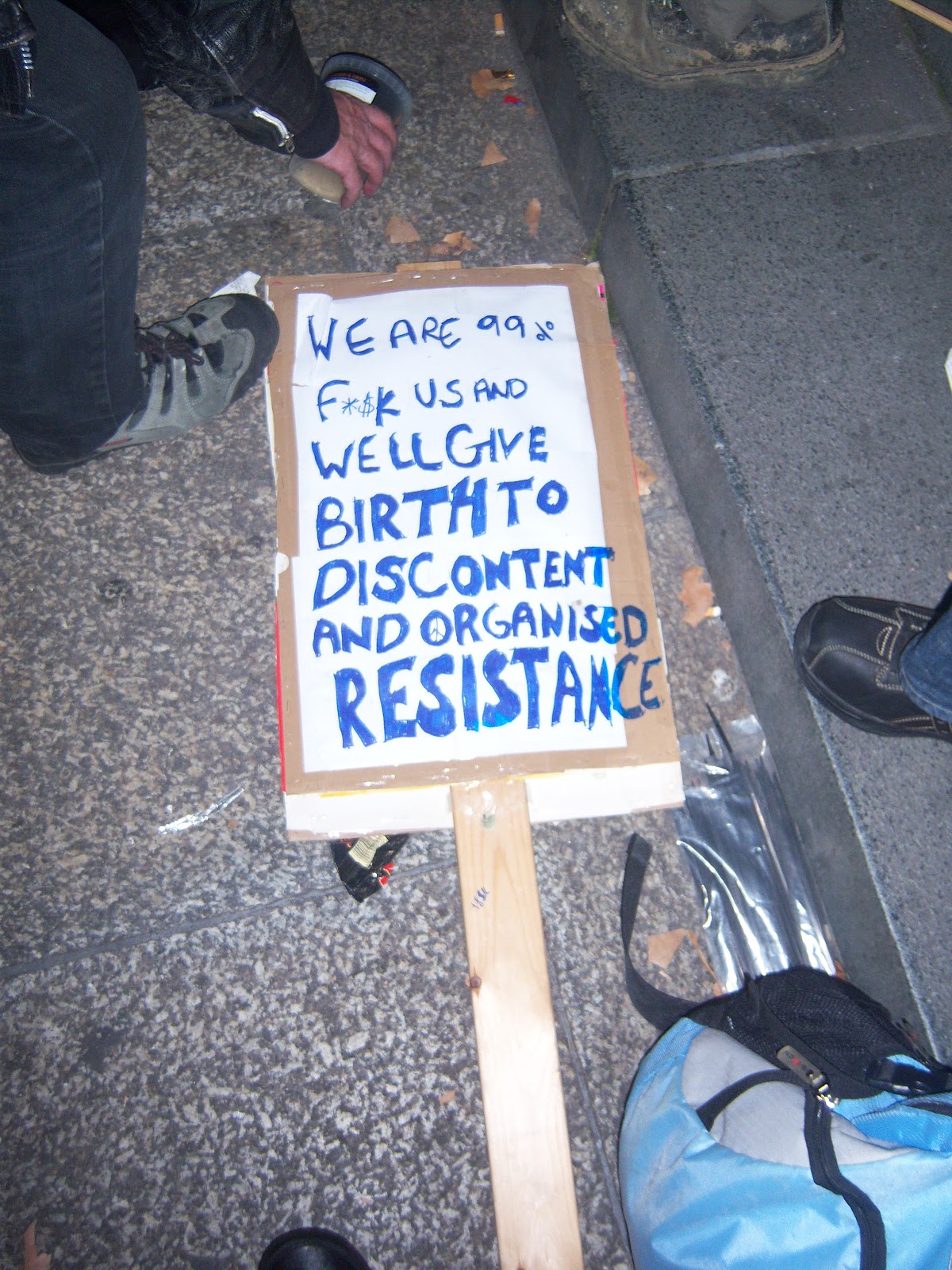
The third recurrent theme is anger; the anger is against the government and the bankers. The key slogan of the movement is “We are the 99 per cent”, as opposed to the rich 1 per cent that runs banks, corporations and governments. “I am 1 of 99 per cent”, “Bankers are the Real Looters”, so read many placards and banners. Another read: “We are 99%. F*$k us and we’ll give birth to discontent and organised resistance”. Yet another read: “Authorities are not Truth; Truth is the Authority”. A banner in front of one tent read: “We don’t need Sex. The Government F*$ks us”.


By Sunday night, the number of tents had multiplied. People brought chairs in, sat outside their tents and read or discussed. One was reading “A Radical Reader”, another was reading “The Jewish Question”, and many others were picking up books from a make-shift library that had just opened.


Singers and performers have come in. One performer was a magician; he enthralled the crowd by making pennies disappear from between his fingers, and said: “that is how our banks make our pennies disappear”. Others performed juggling tricks. A sing-a-long was on nearby; the lines went: “When you talk on your phone, Be careful what you say, They’re Going to Get You…”. The singer gave me the You Tube link to the song he had recorded and uploaded; he is here.


Finally, the million-dollar question: how sustainable is this “movement”? To hazard an answer to this question is risky, as the experience with many recent “movements” has taught us much. This can blow up into a big, long sit-in, and surprise many. Or it could just fizzle out in a day or two. I went around asking the question: who is leading this? I am led to a small tent, with about seven computers. That’s the office, it seems. But then I figured out that there are many groups in there, most of whom don’t even know each other. They arrange regular corner meetings to discuss “strategy”; I heard many of them discussing how to bring in more people the next day and making sure this siege doesn’t end soon.


Hughes, a veteran trade unionist selling books at the venue, told me that most participants are from fringe anarchist groups, and many don’t even know what it means to be an anarchist. “You have to organise, and these guys have to get that simple point”, said Hughes. For him, the success of the siege lies in whether these anarchist groups connect with worker’s unions as quickly as possible, and spread the revolt. He said: “the government is cool about this; they don’t mind this sit-in; this does not disturb anything in the government or among the powerful; but it will do so once these guys connect with the simmering discontent among workers”.


Hughes’ arguments are much the same as what Noam Chomsky said in London last weekend, at the Rebellious Media Conference. Talking about the Wall Street protests and the protests in Egypt and Tunisia, Chomsky said: “It’s when the labour movement began to seriously participate that the gains of these movements really became noticeable…That ought to be known if the occupy movements, spectacular as they are, are going to have real success.”

“Will that happen?”, I asked Hughes. He gave me a telling look, and said with a smile: “Let’s see”.

Let’s see…


Creative Commons Licence
From the sides of "Occupy London" by R. Ramakumar is licensed under a Creative Commons Attribution-NoDerivs 3.0 Unported License.
Based on a work at ramakumarr.blogspot.com.